
316L Stainless Steel Wire for Surgical Instruments & Medical Devices (ASTM A580)
Corrosion-resistant austenitic stainless steel wire for surgical instruments, catheter components, device springs and needles — the workhorse molybdenum-bearing grade when 302/304 needs better chloride resistance.
- Grade equivalents: AISI 316L · UNS S31603 · EN 1.4404 / X2CrNiMo17-12-2 · JIS SUS316L
- Wire diameter: 0.05 – 1.0 mm, custom tolerances on request
- Delivery conditions: soft-annealed, 1/4–1/2 hard, spring temper
- EN 10204 3.1 mill test certificate with every lot
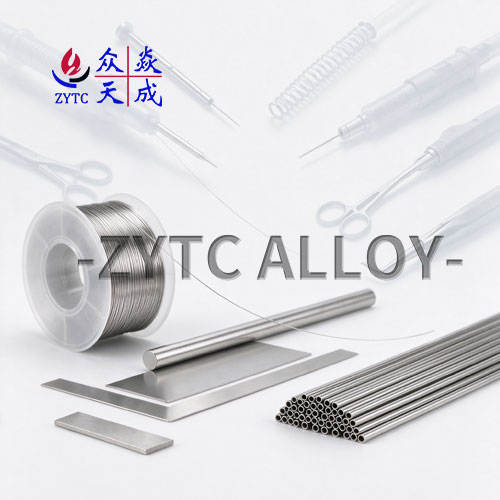

Why 316L for Instruments and Devices?
Adding ~2.5% molybdenum to the 18-8 formula gives 316L a decisive edge in the environments surgical instruments and device components actually see: repeated autoclaving, saline and bodily fluids, chlorhexidine and peroxide-based disinfectants, and marine-atmosphere logistics.
Compared with 302/304 wire, 316L offers:
- Markedly better pitting and crevice corrosion resistance — the molybdenum raises resistance to chloride attack, the dominant failure mode for fine wire in cleaning baths and service
- Low-carbon chemistry (≤0.03% C) — eliminates sensitization risk during any welding or thermal processing, so corrosion performance survives fabrication intact
- Reliable strength with outstanding formability — draws to fine diameters, coils and forms without cracking, then holds up under cyclic loading in device mechanisms
Compared with implant-grade 316LVM, this A580-grade wire is the economical, fully adequate choice for anything that is not implanted. If your component will be implanted — even temporarily — please use our ASTM F138 / ISO 5832-1 implant-grade wire instead; regulators will ask for that documentation.
Typical Applications
- Surgical instrument components: scissor and forceps inserts, retractor springs, needle-holder jaws
- Hypodermic and biopsy needle wire (pre-form condition)
- Catheter reinforcement coils and mandrel wire
- Device springs: stapler, lancet, pump and endoscope mechanisms
- Dental and orthodontic instruments
- Marine and laboratory hardware where chloride exposure rules out 304
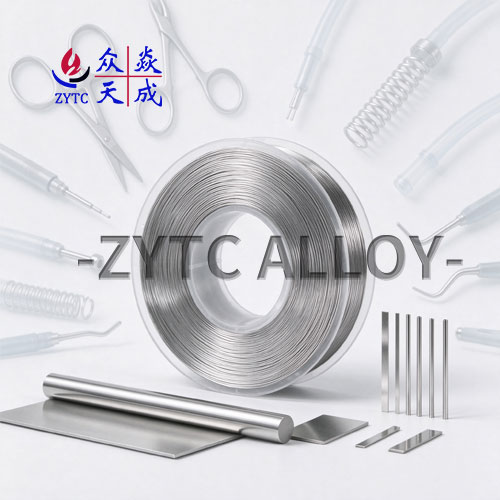
Chemical Composition (wt%) — per ASTM A580 / EN 10088-3
|
Element |
Limit |
|---|---|
|
Carbon (C) |
≤ 0.030 |
|
Silicon (Si) |
≤ 1.00 |
|
Manganese (Mn) |
≤ 2.00 |
|
Phosphorus (P) |
≤ 0.045 |
|
Sulfur (S) |
≤ 0.030 |
|
Chromium (Cr) |
16.00 – 18.00 |
|
Nickel (Ni) |
10.00 – 14.00 |
|
Molybdenum (Mo) |
2.00 – 3.00 |
|
Nitrogen (N) |
≤ 0.10 |
Each heat verified by optical emission spectroscopy; results reported on the EN 10204 3.1 certificate. If your RFQ specifies JIS G4314 or EN 10270-3, we certify to the governing standard stated on your order.
Mechanical Properties & Delivery Conditions
|
Condition |
Typical tensile strength* |
Elongation |
Typical use |
|---|---|---|---|
|
Soft-annealed |
≈ 550–650 MPa |
≥ 35% |
Forming, machining blanks, needle pre-forms |
|
1/4 hard – 1/2 hard |
≈ 900–1400 MPa |
10–25% |
Formed parts, moderate springs |
|
Spring temper |
≈ 1600–2300 MPa (decreases with diameter) |
1–5% |
Precision device springs |
\* Indicative ranges; spring-wire values are governed by diameter under ASTM A313 / JIS G4314 / EN 10270-3 and actual values are certified per lot.
Physical properties
- Density: 7.9 g/cm³ (0.286 lb/in³)
- Modulus of elasticity: ≈ 193 GPa (28.0 × 10³ ksi)
- Non-magnetic annealed; slight magnetism in heavy cold-worked temper
- Melting range: ≈ 1375–1400 °C (2505–2555 °F)
Surface Condition & Packaging
- Bright drawn: standard finish for medical-device processing
- Soap / lime coating: for customer downstream drawing operations
- Electropolishing & passivation (ASTM A967): available on wire or finished parts
- Cleanliness: controlled lubricant residue for medical lots; cap-line packaging; residue/particulate testing on request
- Packaging: spools, coils or cut lengths; vacuum or VCI packaging for sea freight
Quality Assurance & Traceability
- ISO 9001 quality management system
- OES chemistry verification per heat; tensile and dimensional testing per lot
- EN 10204 3.1 certificate: chemistry, mechanical results, diameter/tolerance, heat number
- Third-party inspection (SGS, TÜV, BV) and 3.2 certification available
- Heat/lot traceability from melt to final spool; records retained 10+ years
FAQS
Q1. What is the difference between 316L and 316LVM wire?
Both are low-carbon 18-8-Mo stainless steels. 316LVM is refined for permanent implantation: vacuum (VIM+VAR) melting and tighter P/S limits under ASTM F138 / ISO 5832-1. For instruments and non-implant device components, this A580-grade 316L is fully adequate and more economical.
Q2. Is this wire suitable for implantable devices?
No — specify our 316LVM ASTM F138 / ISO 5832-1 grade for any component that will be implanted, even temporarily. The regulatory documentation for implants is different, and auditors will check.
Q3. 316L vs 302/304 — when is the upgrade worth it?
When the part sees chlorides: autoclave water, saline, disinfectants, marine exposure. If your 304 springs are showing rust or pitting, 316L is the standard upgrade; strength in spring temper is comparable.
Q4. Can 316L wire be autoclaved?
Yes — 316L withstands repeated steam autoclaving and common instrument-sterilization cycles. Passivated, clean-surface wire is recommended for the best appearance after cycles.
Q5. Is 316L wire magnetic?
Annealed 316L is essentially non-magnetic. Spring-temper (heavy cold drawn) wire can show slight magnetism from strain-induced martensite — specify on the certificate if it matters.
Q6. What tolerances can you hold?
Standard tolerances per ASTM A313 / JIS G4314; tighter tolerances (e.g., ±0.002 mm class on selected diameters) on request. Send your drawing for capability confirmation.
Q7. Do you support prototype orders?
Yes — small MOQ for prototypes and samples, volume pricing for production, consistent quality across both.
Q8. Can you supply coated wire (PTFE, nickel, silver)?
Basic coated products are available; for specialized medical coatings we can supply bare wire to your coating partner’s specification.
Why Source 316L Instrument Wire from ZYTC Alloy?
- One production line, multi-standard certification: ASTM / JIS / EN / GB
- 0.05–1.0 mm in soft to spring temper, bright or coated
- Medical-lot surface control and documentation
- EN 10204 3.1 traceability on every spool
- Clear material-selection guidance — including when to choose implant-grade 316LVM instead
ZYTC Alloy — specialty stainless and nickel alloy wire for medical engineering, precision springs and industrial applications. ISO 9001 quality system; exports to North America, Europe and Southeast Asia.
Contact
Email: daisy@zytcsteel.com
WhatsApp / WeChat: +86 173 3575 3350