
Vacuum-remelted surgical implant wire, double-melted by VIM + VAR and certified to ASTM F138 / ISO 5832-1 — the material standard the world’s orthopedic and cardiovascular device makers specify for implantable stainless steel.
- Grade equivalents: 316LVM · UNS S31673 · ISO 5832-1 · ASTM F138 (bar & wire for surgical implants)
- Wire diameter: 0.05 – 1.0 mm, implant-grade tolerances on request
- Melt practice: vacuum induction melting (VIM) + vacuum arc remelting (VAR)
- EN 10204 3.1 certificate per lot; supporting documentation for ISO 10993 evaluation
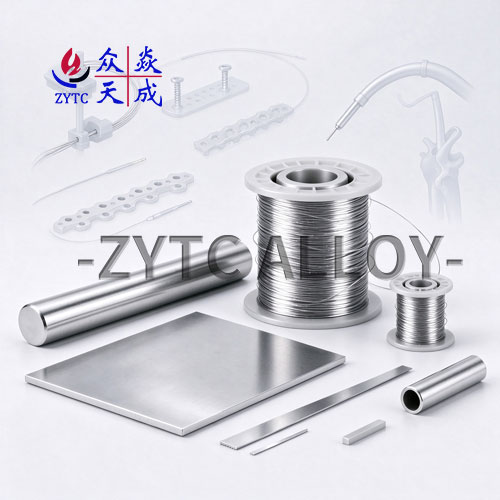

What Makes 316LVM Different from Ordinary 316L?
“316L” is a family, not a single material. The grade sold for springs and instruments meets ASTM A580 — good steel, but its phosphorus, sulfur and inclusion levels are not controlled for permanent implantation. Implant-grade 316LVM is a different product in three concrete ways:
- Tighter chemistry. ASTM F138 caps phosphorus at ≤0.025% and sulfur at ≤0.010% — versus ≤0.045% / ≤0.030% in A580. Lower P and S mean fewer brittle phases at grain boundaries and more consistent fatigue behavior inside the body.
- Vacuum remelting. F138 material must be melted by VIM followed by VAR or ESR remelting. The second melt dramatically reduces oxide inclusions — the initiation sites for both fatigue cracks and the corrosion cells that concern implant biocompatibility.
- Documented cleanliness. Implant lots carry certification against the F138/ISO 5832-1 specification itself, not just a generic 316L chemistry range — the documentation device manufacturers need for their regulatory files.
If your component will be implanted for more than transient contact, specify 316LVM to F138/ISO 5832-1. For surgical instruments and device components without implantation, our instrument-grade 316L wire (ASTM A580) is the more economical choice — see the comparison below.
Typical Implant Applications
- Sternal cerclage (fixation) wire in cardiothoracic surgery
- Temporary fracture-fixation wire, K-wire applications
- Bone plates and screws (where stainless steel is still specified — note the market shift toward titanium, below)
- Surgical mesh and suture wire components
- Components of temporary implants and surgical aids
Engineering note: for permanent load-bearing orthopedic implants, titanium alloys (ISO 5832-3) and cobalt-chromium (ISO 5832-12) have taken significant share from stainless steel because of elastic-modulus and stress-shielding considerations. 316LVM remains dominant where ductility, formability and cost matter most — fixation wire being the clearest example. If you are selecting a material for a new implant design, tell us the loading mode and we will help you shortlist.
Chemical Composition (wt%) — per ASTM F138 / ISO 5832-1
|
Element |
Limit |
|---|---|
|
Carbon (C) |
≤ 0.030 |
|
Silicon (Si) |
≤ 0.75 |
|
Manganese (Mn) |
≤ 2.00 |
|
Phosphorus (P) |
≤ 0.025 |
|
Sulfur (S) |
≤ 0.010 |
|
Chromium (Cr) |
17.00 – 19.00 |
|
Nickel (Ni) |
13.00 – 15.00 |
|
Molybdenum (Mo) |
2.25 – 3.00 |
|
Nitrogen (N) |
≤ 0.10 |
|
Copper (Cu) |
≤ 0.50 |
Note the differences from instrument-grade 316L: tighter P/S, silicon capped at 0.75%, and nickel held at 13–15%. Each heat is verified by optical emission spectroscopy plus inert-gas fusion for N/O; results are reported on the 3.1 certificate.
Mechanical Properties (typical, annealed condition)
|
Property |
Typical value |
|---|---|
|
Tensile strength |
≥ 515 MPa (75 ksi) |
|
0.2% yield strength |
≥ 205 MPa (30 ksi) |
|
Elongation |
≥ 40% |
|
Modulus of elasticity |
≈ 193 GPa (28.0 × 10³ ksi) |
|
Density |
7.9 g/cm³ (0.286 lb/in³) |
Cold-worked conditions (1/4 hard through spring temper) are available for applications needing higher strength; actual values are certified per lot. Wire in the cold-worked state may show slight magnetism from strain-induced martensite.
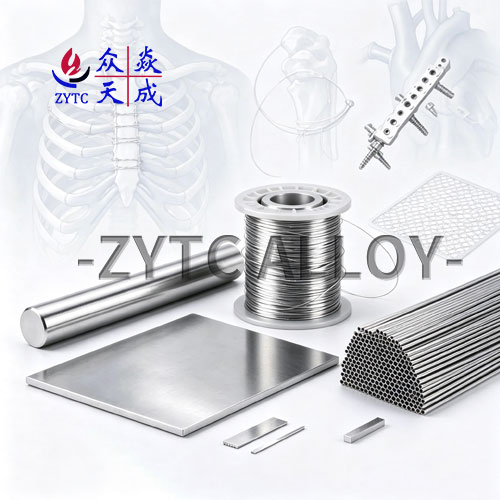
Surface, Passivation & Regulatory Support
- Surface condition: bright drawn, precision clean; electropolishing and passivation per ASTM A967 practice available
- Cleanliness: controlled lubricant residue; final cleaning and cap-line packaging for implant lots; particulate and residue testing available on request
- Documentation: EN 10204 3.1 (chemistry incl. N/O, mechanical results, heat number); melt practice declaration (VIM+VAR); certificates state conformance to ASTM F138 / ISO 5832-1
- Biocompatibility support: wire is produced under controlled melt and surface practices suitable for downstream ISO 10993 evaluation; historical test data can be provided under NDA
- Important: we supply raw material, not finished medical devices. Regulatory clearance of the finished device remains the responsibility of the device manufacturer
Quality Assurance & Traceability
- ISO 9001 quality management system with controlled procedures for medical lots
- VIM + VAR double melt with full melt-record retention (10+ years)
- OES chemistry + N/O analysis per heat; tensile and dimensional testing per lot
- Ultrasonic and eddy-current flaw detection available on bar and larger wire
- Heat/lot marking from melt to final spool — full upstream and downstream traceability
- Third-party inspection (SGS, TÜV, BV) and 3.2 certification available
Frequently Asked Questions
Q1. What is the difference between 316L and 316LVM?
Same base alloy family. 316LVM is 316L refined for implantation: vacuum remelting plus tighter P/S/silicon limits under ASTM F138 / ISO 5832-1. Ordinary 316L (A580) is suitable for instruments and devices but is not certified for permanent implantation.
Q2. Which standard should I specify for implant wire — F138 or ISO 5832-1?
They are technically aligned equivalents: F138 is the ASTM route common in the US, ISO 5832-1 is the international/European route. Device makers typically cite the one matching their regulatory market. Tell us your target market and we certify accordingly.
Q3. Can I use instrument-grade 316L for temporary implants?
We advise against it. Implant-grade documentation is what regulators and notified bodies expect, even for short-term implants. The cost difference on a per-part basis is small; the audit risk is not.
Q4. What melt practice do you use, and can you prove it?
VIM + VAR double melting, declared on each certificate with melt numbers cross-referenced to the original melt records.
Q5. Do you supply bone plates and screws, or only wire?
Our core form is wire (0.05–1.0 mm). We can discuss machined or forged semi-finished components on a project basis; for volume machined implants, most customers buy our wire/bar and machine in their own validated facilities.
Q6. What tolerances are achievable on fine implant wire?
Standard per ASTM F138 tables; tighter tolerances on selected diameters are available. Send your drawing — we confirm capability before quoting.
Q7. Can you support ISO 10993 biocompatibility evaluation?
We provide material certificates, melt practice documentation and, under NDA, historical biocompatibility test data on comparable lots. Final device testing remains with the device manufacturer.
Q8. What are your MOQ and lead time?
MOQ from 10 kg for stock diameters; implant lots typically ship in 2–4 weeks depending on condition and testing scope.
Why Source Implant-Grade 316LVM from ZYTC Alloy?
- Certified to ASTM F138 / ISO 5832-1 — not “316L claimed for implants”
- VIM + VAR double melt with melt records retained 10+ years
- Full EN 10204 3.1 documentation supporting regulatory files
- Fine-wire specialization: 0.05–1.0 mm with implant-grade surface control
- Prototype quantities supported; scale to production volumes
ZYTC Alloy — specialty stainless and nickel alloy wire for medical engineering. ISO 9001 quality system; exports to North America, Europe and Southeast Asia.