Blog

https://zytcmedical.com/product-category/cobalt-alloys/

Inner Bore Roughness in Micro Catheters: Specifying Ra for Aspiration and Guidewires

When a catheter shaft is drawn, the drawing puts the outer diameter and wall thickness on the first page. The inner bore usually appears as one line item, if it appears at all. In a micro catheter, though, the bore is the surface every guidewire advances against, and the channel every clot or aspirated volume

Inner Bore Roughness in Micro Catheters: Specifying Ra for Aspiration and Guidewires Read More »
Elgiloy Micro Tubing

Elgiloy Micro Tubing (UNS R30003) for Catheters: When to Leave 316L Behind

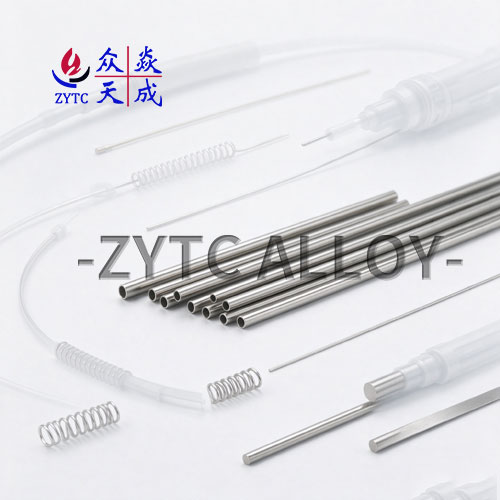
The design problem on a modern catheter is always the same conversation: pushability versus lumen, wall thickness versus outer profile, fatigue life versus cost. Cold-drawn 316L carries most of that load comfortably. It stops carrying it when the profile gets thin enough that the wall has to be shaved below what 316L strength can hold.

Elgiloy Micro Tubing (UNS R30003) for Catheters: When to Leave 316L Behind Read More »

ASTM F75 vs. ASTM F1537 vs. ISO 5832-12: A Purchasing Guide to CoCrMo Alloys

Three standards, one alloy family, two process routes. CoCrMo is the default bearing and structural alloy for hip and knee implants, and almost every specification conversation about it comes down to three documents: ASTM F75, ASTM F1537, and ISO 5832-12. They describe the same alloy family produced by different routes, and the differences between them

ASTM F75 vs. ASTM F1537 vs. ISO 5832-12: A Purchasing Guide to CoCrMo Alloys Read More »

Why MP35N (UNS R30035) is the Premier Cobalt Alloy for Medical Devices

In the rapidly evolving world of medical device engineering, finding a material that perfectly balances extreme strength, exceptional fatigue resistance, and biocompatibility is a constant challenge. For applications ranging from self-expanding vascular stents to high-tension orthopedic cables, engineers consistently turn to one material: MP35N (UNS R30035). At ZYTC Alloy, we supply premium medical-grade MP35N in

Why MP35N (UNS R30035) is the Premier Cobalt Alloy for Medical Devices Read More »

Why Nitinol Af Temperature Must Be Verified on the Finished Tube, Not the Ingot

Why Ingot-Only Af Testing Fails: Verifying Nitinol Tube Transformation Temperatures

In the design of self-expanding stents, catheter delivery systems, and other minimally invasive devices, the Austenite Finish temperature (Af) of Nitinol is arguably the most critical parameter. It dictates the temperature at which the material completes its transformation to austenite and exhibits its full superelastic, shape-memory behavior. However, ZYTC Alloy frequently reviews material test reports

Why Ingot-Only Af Testing Fails: Verifying Nitinol Tube Transformation Temperatures Read More »

Advanced Metals in Medical Devices: From Prototyping to Mass Production

The medical device industry is evolving faster than ever. From minimally invasive surgical instruments to next-generation orthopedic implants, the push for smaller, smarter, and more durable devices relies heavily on advanced materials. At ZYTC Alloy, we understand that the foundation of any breakthrough medical device is the raw material. We partner with medical OEMs to

Advanced Metals in Medical Devices: From Prototyping to Mass Production Read More »

316LVM vs. 316L Stainless Steel: What’s the Difference & Which to Choose for Medical Implants?

In the world of medical device manufacturing, choosing the right material is a matter of life and death. When it comes to stainless steel, 316L and 316LVM are two of the most common grades specified in engineering drawings. At first glance, their chemical compositions seem almost identical. However, the difference in their manufacturing processes—and the

316LVM vs. 316L Stainless Steel: What’s the Difference & Which to Choose for Medical Implants? Read More »

How-to Audit Medical Alloy Suppliers

How to Audit Medical Alloy Suppliers: Micro-cleanliness Testing Guide

How to Audit a Supplier’s Micro-cleanliness Testing Capability for Medical Alloys In the procurement of medical alloys, micro-cleanliness is often the hidden variable that determines the fatigue life of an implant. A batch with oversized inclusions might pass all assembly tests, only to become a crack initiation site after millions of cycles inside a patient’s

How to Audit Medical Alloy Suppliers: Micro-cleanliness Testing Guide Read More »

Understanding Nitinol

Understanding Nitinol: Superelasticity, Shape Memory, and Medical-Grade Specifications

Nitinol (Nickel-Titanium alloy) is one of the most remarkable materials used in modern medical device manufacturing. Unlike conventional metals that permanently deform when strained beyond their elastic limit, Nitinol possesses two unique properties: superelasticity and the shape memory effect. At ZYTC Alloy, we supply premium medical-grade Nitinol tailored for the most demanding applications, from self-expanding

Understanding Nitinol: Superelasticity, Shape Memory, and Medical-Grade Specifications Read More »

Precision Machining for Medical-Grade Alloys

Medical device manufacturing sets one of the world’s strictest bars for metal processing. Even a micrometre-level dimensional deviation, poor surface finish, or residual contamination can compromise implant biocompatibility, surgical instrument performance, and ultimately patient safety. For cobalt-chromium, titanium, medical stainless steel, and nitinol raw materials, precision machining is far more than cutting metal to size—it

Precision Machining for Medical-Grade Alloys Read More »

Scroll to Top