
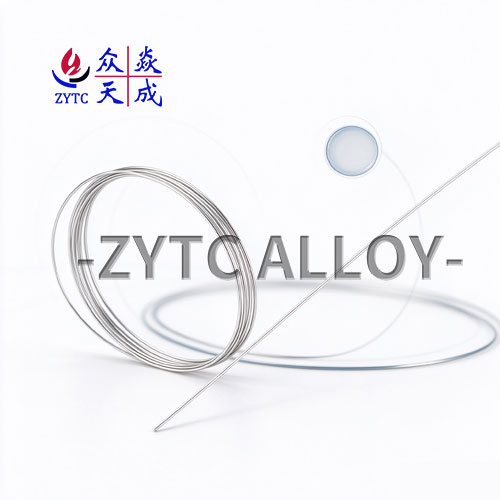
304V is a vacuum-arc-remelted 304 stainless steel with reduced inclusions and improved structural uniformity — the most common alloy in medical wire. ZYTC Alloy supplies 304V wire with a 5–7 μm medical-grade lubricious coating, combining low friction, wide temperature stability, and anti-static performance. Wire diameter range: 0.05–1.0 mm.

Coating Performance
Why 5–7 μm. Coating thickness is a trade-off: too thick changes flexibility and torque transmission on fine wire; too thin gives no sustained lubrication. Merit OEM data show PTFE coatings run 2–7 μm per side for wire ≤0.254 mm and 4–10 μm for wire ≥0.254 mm — your 5–7 μm specification fits the 0.05–1.0 mm range.
Temperature boundary. Long-term -200°C to 260°C, short-term 300°C. Note that Merit rates PTFE coatings to <220°C and Alleima’s 304V datasheet gives 250°C — your 260°C is slightly higher, so state the test basis (coating thermal stability vs. adhesion retention) in the technical agreement. For 134°C autoclave cycles, 260°C gives ample margin; for transient exposure above 300°C, confirm coating integrity.
Lubricity and anti-static. The coating reduces guidewire-to-catheter friction. Anti-static behavior helps in cleanroom assembly and near electronic sensors. Whether lubricity survives coiling depends on the adhesion process — run a friction or simulated-friction test at first-article approval, not just a thickness check.
Core Wire: 304V Performance Basis
Vacuum remelting reduces inclusions, directly affecting fine-wire drawing and fatigue life. Fort Wayne Metals data: 304V reaches ~1434 MPa at 50% cold work, ~1827 MPa at 75%, up to ~2303 MPa at 95%. The core’s cold-work condition sets final strength; the coating does not change it. Alleima’s medical 304V datasheet gives -200 to 250°C service, with tensile ~2365 MPa at 0.15–0.20 mm and ~2150 MPa at 0.50–0.65 mm.
Supply Specifications
| Item | Parameter |
|---|---|
| Core material | 304V (UNS S30400, vacuum remelted) |
| Wire diameter | 0.05 – 1.0 mm |
| Coating thickness | 5 – 7 μm |
| Long-term temperature | -200°C to 260°C |
| Short-term tolerance | 300°C |
| Coating properties | Lubricious, anti-static |
| Supply form | Coil / cut-to-length / straightened |
| Certificate | EN 10204 3.1, with core chemistry and measured coating thickness |
Diameter vs. coating note: Near 0.05 mm, the coating is a large fraction of core diameter — confirm coated overall OD meets assembly clearance and that coiling does not crack the coating. Near 1.0 mm, coating proportion is smaller and lubricity retention is better, but adhesion under bending should still be verified.
Product Applications
-
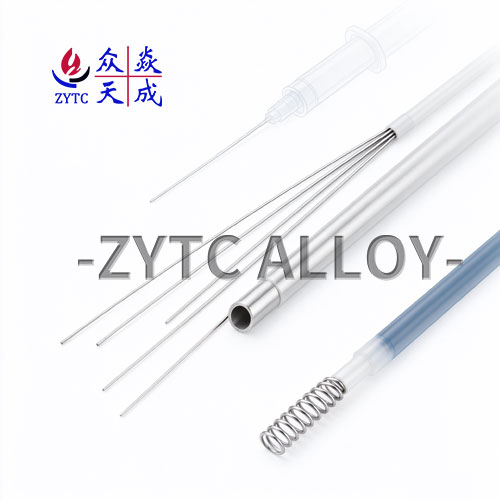
Guidewires and catheters — reduced friction against the catheter lumen, improved trackability, less vessel trauma; anti-static behavior aids cleanroom assembly.
-
Hypodermic needles and cannulas — smooth insertion and consistent penetration force; wide temperature range suits autoclave cycles.
-
Endoscopic and laparoscopic instruments — inner actuation wire with low friction in the working channel and stable performance after repeated sterilization.
-
Orthodontic archwires — reduced archwire-bracket friction; confirm coating durability against saliva for long-term intraoral use.
-
Springs and precision coils — reduced inter-coil friction and wear in repeated actuation.
-
Instrument cables and tethers — combined flexibility, corrosion resistance, and low surface friction.
-
Filter and retrieval devices — lubricity aids deployment; temperature range supports sterilization protocols.
Processing Notes
Coating integrity before coiling. Bending and friction during coiling can cause micro-cracks or delamination if adhesion is insufficient. Run a coating continuity check (visual or low-magnification) after coiling.
Sterilization compatibility. PTFE coatings tolerate autoclave cycles, but lubricity retention after repeated cycles depends on curing and surface pretreatment. For reusable devices, request pre/post-sterilization friction data or the supplier’s sterilization compatibility conclusions.
Welding and laser cutting. Remove the coating before welding. Laser cutting may leave burrs or delamination at the coating edge — plan a follow-up step.
Why ZYTC Alloy
-
Core and coating data both reported — 304V chemistry (with vacuum remelt statement) and measured coating thickness, not just “conforms.”
-
Diameter/coating matching confirmed — for near-0.05 mm or coiling orders, we confirm coated OD and coiling suitability before quoting.
-
Certification — AS9120B and ISO 9001; EN 10204 3.1 certificate.
-
Lead time — standard diameters 7–10 days; non-standard or custom coating 3–4 weeks; FOB.
Request a Quote
Please provide: wire diameter, coating thickness requirement (or acceptance of 5–7 μm), supply form, downstream operation (coiling / cutting / direct assembly), whether sterilization compatibility data is required, and quantity.
If diameter is near 0.05 mm or coiling is required, note this — we will confirm coated OD and adhesion suitability.
📧 daisy@zytcsteel.com
📲 WhatsApp / WeChat: +86 17335753350