
— Product Details & Selection Guide
For needle, cannula, fluid line, and surgical instrument design engineers — supplied by ZYTC Alloy, ISO 9001 certified manufacturer and exporter
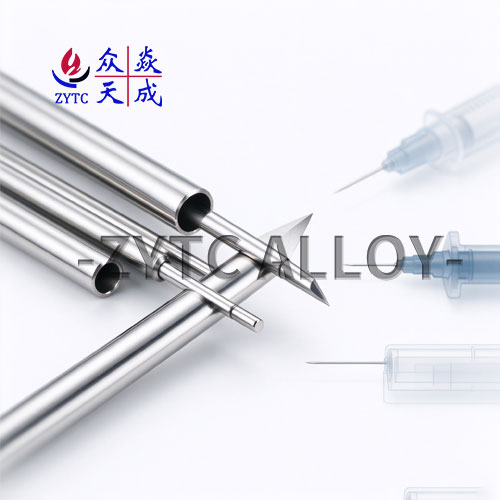
SUS 304 (UNS S30400) medical stainless steel capillary tube is a precision seamless tube produced by cold drawing, with outer diameter from 0.2 to 10.0 mm and wall thickness from 0.05 to 1.5 mm. The material offers good formability, dimensional stability, and corrosion resistance, making it suitable for non-implantable medical devices — fluid transfer, needle cannulas, instrument sleeves, and precision structural components.
ZYTC Alloy supplies SUS 304 capillary tube with Bright Annealed (BA), polished, or pickled surface, with cut-to-length and downstream processing support.
Important positioning: SUS 304 is not intended for long-term human implantation. Components requiring long-term implantation or prolonged body-fluid contact should use medical-grade 316LVM (ASTM F138). All selection guidance below applies to non-implantable applications.

Material Advantages
Controllable dimensional precision. Cold drawing delivers stable OD and wall thickness tolerance. For needle grinding or precision flow lines, incoming tolerance consistency directly affects downstream yield.
Good formability. The annealed condition suits bending, flaring, and precision machining. For multi-bend components (instrument sleeves, guidewire outer tubes), 304 offers a wider forming window than precipitation-hardening stainless steels.
Reasonable cost. In non-implantable, single-use, or short-contact devices, 304 provides a more economical material choice than 316L where performance requirements are met.
Selectable surface condition. BA surface offers lower internal roughness for flow-sensitive lines; polished surface suits appearance parts and higher cleanliness requirements; pickled surface suits subsequent welding or general forming.
Typical Applications
| Application | Typical component | Key requirement |
|---|---|---|
| Injection & blood collection | Hypodermic needle cannulas, blood collection needles | Stable OD tolerance, consistent bevel grinding |
| Fluid transfer | Infusion pump restrictor tubes, sampling lines, catheter connectors | Internal roughness, flow consistency, leak-free |
| Surgical instruments | Ultrasonic scalpel outer sleeves, tubular instrument structures | Wall thickness uniformity, bend formability |
| Dental & orthodontics | Orthodontic attachments, instrument tubing | Cost vs. corrosion balance (note chloride-rich oral environment) |
| Equipment internal lines | Medical device internal fluid lines, cleanroom equipment tubing | Cleanliness, resistance to common cleaning agents |
Selection note: The oral environment contains chloride ions, and 304 carries a pitting risk in long-term contact with saliva. For long-term intraoral use, evaluate 316L or a surface treatment option.
Technical Specifications
| Parameter | Standard range | Customizable |
|---|---|---|
| Material grade | SUS 304 / UNS S30400 | — |
| Outer diameter (OD) | 0.2 – 10.0 mm | Per drawing |
| Wall thickness (WT) | 0.05 – 1.5 mm | Per drawing |
| Tolerance | Precision cold-drawn | Tighter tolerance available |
| Surface | BA / polished / pickled | Matched to downstream process |
| Supply length | Cut-to-length or coil | Cut as required |
| Formability | Annealed, suitable for bending, flaring, machining | — |
| Corrosion resistance | General medical environments (non-implant) | — |
Tolerance note: Standard tolerance suits general use. If the tube is for needle bevel grinding or multi-bend forming, specify OD actual distribution or wall thickness uniformity on the PO rather than accepting “within standard tolerance” alone. Incoming dimensional stability often affects downstream yield more than the material price difference.
Processing & Use Notes
Needle bevel grinding. OD tolerance directly affects bevel symmetry after grinding. For high-volume needle production, request per-lot OD measurement data from the supplier to assess grinding allowance consistency.
Bend forming. Wall thickness uniformity matters more than OD tolerance. The thin-wall side wrinkles or cracks first during bending. For multi-bend tubes, specify wall thickness tolerance separately.
Welding. BA surface is generally suitable for direct welding, but oil or particles on cut ends from handling or storage increase porosity. Incoming packaging and storage conditions affect weld yield more than the material itself.
Passivation. For reusable instruments or components contacting body fluids, passivation per ASTM A967 is recommended. Material corrosion resistance does not equal part corrosion resistance — grinding burn or surface iron contamination bypasses the alloy’s inherent resistance, and the certificate will not reflect this.
Sterilization compatibility. 304 withstands autoclave sterilization and common disinfectants. Under repeated exposure to chlorine-based disinfectants, pitting risk is higher than with 316L. Reusable instrument tubular components should be evaluated against this factor.
Why Source from ZYTC Alloy
-
Dimensional data available: Per-lot OD distribution or wall thickness uniformity data can be provided on request to support downstream process validation.
-
Surface matching: BA, polished, or pickled, recommended according to your downstream operation (grinding / bending / welding / passivation).
-
Processing support: Cut-to-length, bend processing, and first-article flow testing coordination.
-
Certification: ISO 9001; EN 10204 3.1 inspection certificate with material traceability.
-
Lead time: Standard sizes 7–10 days; non-standard sizes or custom processing 3–4 weeks; FOB terms.
-
Clear material boundaries: We do not recommend 304 for implant applications; where 316LVM is required, it can be supplied alongside, avoiding a multi-supplier switch.
Request a Quote
Please provide: OD / ID (or wall thickness), length, surface condition, downstream operation (grinding / bending / welding / passivation), quantity, and whether OD measurement data or third-party testing is required.
If the tube is for flow-sensitive lines or high-volume needle production, include the critical dimensions and test method in your inquiry — we will confirm the inspection data we can provide at quotation.
📧 daisy@zytcsteel.com
📲 WhatsApp / WeChat: +86 17335753350