
For stent, guidewire, orthodontic, and minimally invasive device design engineers and buyers — supplied by ZYTC Alloy, ISO 9001 certified manufacturer and exporter
Nitinol is a nickel-titanium alloy combined at approximately a 50:50 atomic ratio. Its material properties and functional behavior are entirely controlled by composition ratio, forming process, and heat treatment — the same grade of Nitinol wire can be adapted to applications from vascular stents to orthodontic archwires by adjusting transformation temperature and mechanical characteristics.
Shape memory alloy (SMA) is the most important and widely used category of Nitinol. It combines shape memory recovery, superelastic fatigue resistance, and biocompatibility, and complies with ASTM F2063 for safe human use — which is why it is widely adopted in aerospace and medical applications.
ZYTC Alloy supplies medical-grade Nitinol wire, diameter range 0.05–5.0 mm, surface available in bright finish or black oxide (as-drawn) finish, with transformation temperature and mechanical properties adjustable to the application.

Chemical Composition (%)
| Element | Content |
|---|---|
| Nickel (Ni) | 55.4 – 57.0 |
| Carbon (C) | ≤ 0.07 |
| Hydrogen (H) | ≤ 0.05 |
| Oxygen (O) | ≤ 0.05 |
| Nitrogen (N) | ≤ 0.05 |
| Titanium (Ti) | Balance |
Procurement note: The nickel window (55.4–57.0%) directly determines transformation temperature. For every 0.1% increase in nickel content, the transformation temperature drops by roughly 10°C. If your application has a defined Af (austenite finish) requirement, specify the target Af or nickel range on the PO — do not accept only “conforms to ASTM F2063” chemistry. Carbon, oxygen, and nitrogen control also affects fatigue life: inclusions are initiation sites for fatigue cracks in Nitinol wire, so lower interstitial limits mean better fatigue performance.
Core Properties
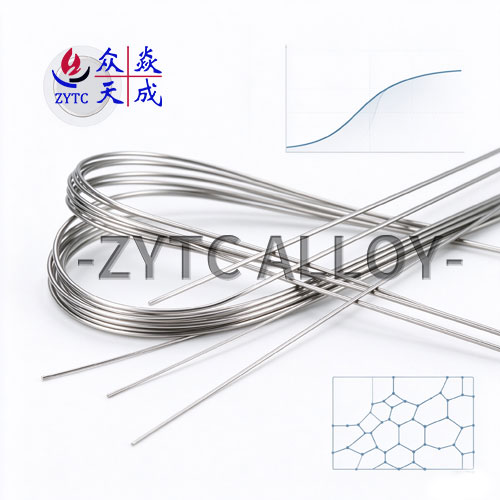
Superelasticity. The material develops strain far beyond its elastic limit under load and recovers that strain automatically on unloading. In the parent phase, applied stress induces martensitic transformation, giving the alloy mechanical behavior unlike ordinary metals — a much higher elastic limit that no longer follows Hooke’s law. Whether bent or stretched, the alloy returns to its original shape once stress is removed, behaving like rubber over a very large elastic range. This property is widely used in springs, alloy wire, apparel, electrical components, dental, and medical applications.
Shape memory effect. The alloy deforms in the low-temperature martensitic state and recovers its original shape when heated above the transformation temperature. This effect simplifies surgical procedures, aligns with the trend toward minimally invasive surgery, and opens new application areas distinct from conventional fixation methods.
Fatigue resistance and biocompatibility. The large strain recovery of superelasticity gives Nitinol wire excellent fatigue resistance under cyclic loading. ASTM F2063 compliance ensures the material is safe for human implantation and short-term contact devices.
Typical Applications
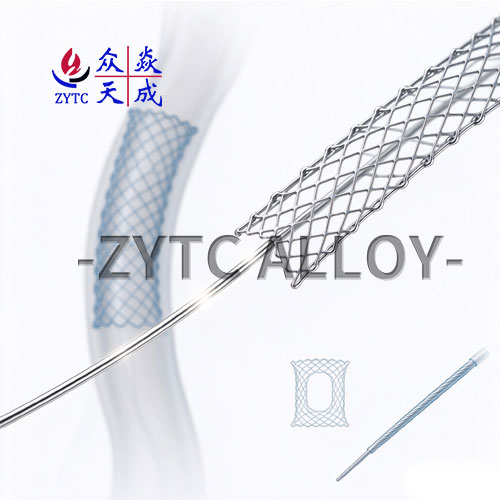
Nitinol stents. Shape memory allows the stent to expand a narrowed vessel without balloon dilation; excellent fatigue strength suits stents throughout the body, particularly carotid and peripheral arteries.
Guidewires and catheters. Superelasticity provides good torque control and flexibility while reducing vessel trauma; adjustable transformation temperature adapts stiffness to different body-temperature requirements.
Orthodontic archwires. Continuous light-force superelastic behavior reduces adjustment frequency; shape memory provides stable corrective force at oral temperature.
Minimally invasive instruments and retrieval devices. Shape memory enables deployment and retrieval within the body, simplifying the procedure.
Springs and precision components. The large elastic range suits space-constrained micro-springs and connectors.
Supply Specifications
| Item | Parameter |
|---|---|
| Wire diameter range | 0.05 – 5.0 mm |
| Surface | Bright finish / black oxide (as-drawn) |
| Standard | ASTM F2063 (medical Nitinol) |
| Transformation temperature | Adjustable to application (state target Af in inquiry) |
| Supply form | Coil / cut-to-length / straightened |
| Certificate | EN 10204 3.1, with measured chemistry and DSC transformation temperature data |
Diameter vs. surface note: Bright finish suits wire requiring precision machining, welding, or direct implantation; black oxide finish retains the surface oxide layer and suits applications where the surface layer will be removed or surface finish requirements are less critical. For fine wire near the 0.05 mm lower limit, surface defects have a more pronounced effect on fatigue life — we recommend a surface integrity check at first-article approval.
Processing & Use Notes
Transformation temperature must be specified on the PO. Nitinol wire performance depends heavily on transformation temperature, which is determined by nickel content and heat treatment. Specifying only “ASTM F2063 compliant” may result in delivery at any transformation temperature within the standard range. For stents or guidewires, an Af deviating from design directly changes device stiffness and recovery force at body temperature.
Forming and heat treatment affect final properties. Setting, coiling, and heat treatment of Nitinol wire change transformation temperature and superelastic behavior. If you will perform forming or heat treatment in-house, state the process route in the inquiry and we can recommend an incoming condition suited to downstream processing.
Surface condition affects corrosion resistance and fatigue. The oxide layer on black oxide finish wire requires evaluation for biocompatibility and corrosion resistance in implant applications; bright finish is better suited to direct body-fluid contact or applications requiring polishing.
Why Source from ZYTC Alloy
-
Transformation temperature specified to order: Certificate provides measured Af by DSC — not just “conforms to ASTM F2063.”
-
Measured chemistry supplied: Nickel content and interstitial elements (C/H/O/N) reported on the certificate, supporting incoming verification for fatigue-critical applications.
-
Diameter and surface matching confirmed: For fine wire near 0.05 mm or orders requiring downstream forming, we confirm surface and incoming condition suitability before quoting.
-
Certification: ISO 9001; EN 10204 3.1 certificate.
-
Lead time: Standard diameters 7–10 days; non-standard diameters or specified transformation temperature 3–4 weeks; FOB terms.
Request a Quote
Please provide: wire diameter, surface condition (bright / black oxide), target Af or transformation temperature range, downstream operation (coiling / forming / heat treatment / direct assembly), quantity, and whether DSC data or third-party testing is required.
📧 daisy@zytcsteel.com
📲 WhatsApp / WeChat: +86 17335753350