
High-strength austenitic stainless steel wire for medical instruments, device components and precision springs — supplied in diameters 0.05–8.0 mm with certified chemistry and full traceability.
- Equivalent grades: SUS 302 (JIS) · AISI 302 / S30200 (ASTM) · EN 1.4310 / X10CrNi18-8 (European)
- Wire diameter: 0.05 mm – 8.0 mm, custom tolerances on request
- Soft-annealed or spring-temper condition
- EN 10204 3.1 mill test certificate with every lot
- MOQ & lead time: flexible for prototypes and volume orders
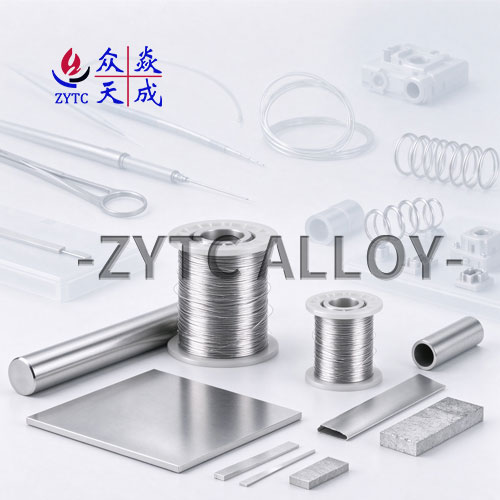

What Is 302 Stainless Steel — and When Should You Choose It Over 304?
302 is an 18-8 austenitic stainless steel (18% Cr, 8% Ni) with a slightly higher carbon window than 304. That small difference drives a practical engineering trade-off:
- Higher strength. Cold-drawn 302 spring wire reaches tensile levels roughly 10–20% above equivalent 304 wire, because more carbon stays in solution to support work hardening during drawing.
- Excellent ductility in the annealed condition. Soft 302 wire draws, forms and bends with ease — the reason it has been a default choice for formed medical wire parts for decades.
- Corrosion resistance comparable to 304 in body-contact and instrument-cleaning environments (water, saline, mild disinfectants).
- Stable high-temperature performance — austenitic structure with no embrittlement range through continuous service around 400–800 °C (note: like all 18-8 grades, prolonged exposure in the sensitizing range reduces intergranular corrosion resistance; keep welded or heat-treated parts within recommended windows).
Choose 302 when the part is cold-formed or spring-loaded and needs more strength than 304 can offer — guidewire core wires, catheter coil and mandrel wire, surgical instrument components, retractor and clamp springs, orthodontic archwire. Choose 304/316L instead when welding-heavy fabrication or maximum corrosion margin (chloride-rich environments) matters more than strength.
Medical & Instrument Applications
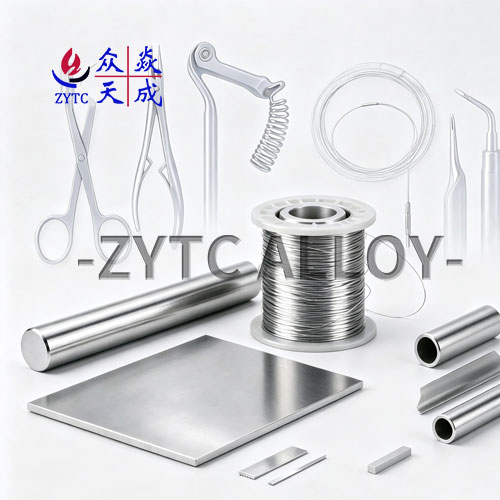
302 wire is widely used in the manufacture of medical instruments and device sub-components — not implants:
- Surgical instrument components: scissor and forceps inserts, needle-holder jaws, retractor springs
- Guidewire core wires and mandrels (typically nickel- or PTFE-coated downstream)
- Catheter and tubing reinforcement coils
- Device springs: lancet, stapler, infusion-pump and endoscope mechanisms
- Orthodontic and dental instrument wire
Materials note: for implantable components, industry practice is to specify 316L or 316LVM under ISO 5832-1. ZYTC Alloy supplies 316L/316LVM wire separately — contact us if your application involves permanent implantation.
Chemical Composition (wt%)
|
Grade |
C |
Si |
Mn |
P |
S |
Cr |
Ni |
N |
|---|---|---|---|---|---|---|---|---|
|
SUS302 / AISI 302 |
≤0.15 |
≤1.00 |
≤2.00 |
≤0.035* |
≤0.03 |
17.00–19.00 |
8.00–10.00 |
≤0.10 |
\* Composition limits per JIS G4314 / JIS G4308. Under ASTM A313 / A580, the phosphorus limit is ≤0.045; please state your governing standard when ordering so we certify to the correct specification.
Mechanical Properties & Delivery Conditions
|
Condition |
Typical tensile strength* |
Elongation |
Typical use |
|---|---|---|---|
|
Soft-annealed (solution annealed, pickled) |
≈ 600–750 MPa |
≥ 35% |
Deep forming, machining blanks |
|
1/4 hard – 1/2 hard |
≈ 900–1400 MPa |
10–25% |
Formed parts, moderate springs |
|
Spring temper (fully cold drawn) |
≈ 1600–2300 MPa (decreases with diameter) |
1–5% |
Precision springs, guidewire cores |
\* Indicative ranges only. Spring-wire tensile values are governed by wire diameter under ASTM A313 / JIS G4314 / EN 10270-3; each lot is tested and actual values are reported on the EN 10204 3.1 certificate.
Physical properties
- Density: 7.9 g/cm³ (0.286 lb/in³)
- Modulus of elasticity: ≈ 193 GPa (28.0 × 10³ ksi)
- Non-magnetic in the annealed condition; slight magnetism develops with heavy cold work
- Melting range: ≈ 1375–1400 °C (2505–2555 °F)
Surface Condition, Cleanliness & Packaging
For medical-instrument wire, surface quality is as important as chemistry:
- Bright drawn (clean finish): standard for spring and forming applications
- Soap / lime-coated drawing: available for heavy drawing operations by the customer
- Electropolishing and passivation: available on finished wire or parts, tested per ASTM A967 practice
- Cleanliness: wire for medical lots is produced with controlled lubricant residue and capped-line packaging; residual contamination testing available on request
- Packaging: spools, coils or cut lengths; vacuum-sealed or VCI packaging for sea freight on request
Quality Assurance & Traceability
- ISO 9001 quality management system
- Each heat verified by optical emission spectroscopy; mechanical tests per delivery condition
- EN 10204 3.1 certificate: chemistry, tensile, diameter/tolerance, heat number
- Third-party inspection (SGS, TÜV, BV) and 3.2 certification available on request
- Biocompatibility-related documentation: material test reports supporting ISO 10993 evaluation are available; wire is produced under controlled processes suitable for downstream medical device manufacturing
- Heat/lot traceability maintained from melt to final spool
Frequently Asked Questions
Q1. What is the difference between 302 and 304 stainless steel wire?
Same 18-8 family. 302 allows slightly more carbon, which raises attainable cold-drawn strength by roughly 10–20% — the reason spring wire is commonly specified as 302. 304 is preferred for welded fabrication and offers marginally better corrosion resistance after welding.
Q2. Is 302 wire magnetic?
Annealed 302 is essentially non-magnetic. Heavy cold drawing (spring temper) induces slight magnetism from strain-induced martensite. If magnetism is critical to your design, specify it — we can confirm values on the test certificate.
Q3. What tolerances can you hold on fine wire?
Standard commercial tolerance for fine wire follows ASTM A313 / JIS G4314 tables; tighter tolerances (e.g., ±0.002 mm class on selected diameters) are available on request. Send your drawing and we will confirm capability before quoting.
Q4. Can 302 wire be autoclaved or sterilized?
Yes — austenitic 302 withstands standard steam autoclaving and common sterilization cycles used for instruments. For device assemblies, validate per your own sterilization process; passivated, clean-surface wire is recommended.
Q5. Is this wire suitable for implantable medical devices?
302 is used for instruments and device components that contact tissue transiently. For permanent implants, specify 316L/316LVM (ISO 5832-1). We supply both — tell us your application and we will recommend accordingly.
Q6. Do you support small prototype orders?
Yes. We support prototype quantities with flexible MOQ and fast lead times; volume pricing applies to recurring production orders.
Q7. Which standards do you certify to?
Common references: ASTM A313 / A580 (wire), JIS G4314 (spring wire), EN 10270-3, EN 10088-3 (grade definition), GB/T 4240. Please state the governing standard on your RFQ.
Q8. Can you supply coated wire (nickel, PTFE, silver)?
Basic coated products are available; for specialized medical coatings we can supply bare wire to the coating partner’s specification or coordinate coating through partner facilities.
Why Source SUS302 Wire from ZYTC Alloy?
- One mill, multiple standards: JIS / ASTM / EN certified from the same production line
- Diameter 0.05–8.0 mm in soft, 1/4–1/2 hard and spring temper
- Medical-oriented surface and packaging options
- Full EN 10204 3.1 traceability on every spool
- Prototype-friendly MOQ with export documentation handled
ZYTC Alloy — specialty stainless and nickel alloy wire for medical engineering, precision springs and industrial applications. ISO 9001 quality system; exports to North America, Europe and Southeast Asia.
Contact
Email: daisy@zytcsteel.com
WhatsApp / WeChat: +86 173 3575 3350