
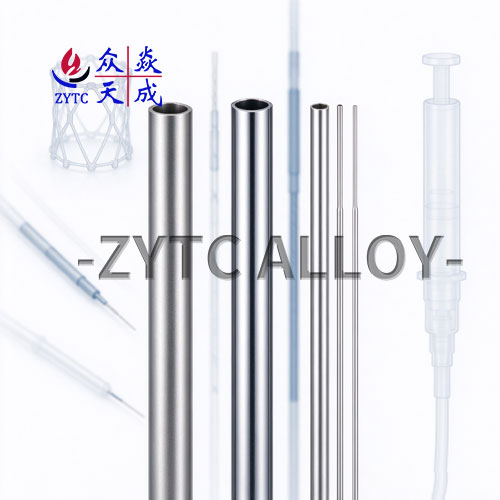
The trend in modern medicine is undeniable: moving from open surgery to minimally invasive procedures. Whether it’s a cardiovascular catheter navigating tortuous arteries, a neurovascular aspiration tube, or a biopsy needle, the success of these devices relies entirely on the micro-tubing from which they are built.
While standard industrial tubes are measured in inches, medical alloy tubes are often measured in micrometers. This drastic reduction in scale changes the metallurgy and manufacturing challenges entirely. In this article, we analyze the critical engineering factors when specifying Medical Alloy Tubes, and how to ensure your supply chain delivers the precision your devices demand.

The Material Selection Matrix for Medical Tubes
Choosing the right alloy tube material is a trade-off between strength, flexibility, and biocompatibility. Here are the three primary categories:
1. Nitinol (NiTi) – The Superelastic Standard
- Application: Self-expanding stents, micro-catheters, guidewire hypotubes.
- The Challenge: Nitinol’s superelasticity (8-10% recoverable strain) is unmatched. However, machining and welding Nitinol is extremely difficult. The key is specifying a precise Austenite Finish Temperature (Af), usually around 37°C, so the tube behaves correctly at body temperature.
2. Cobalt-Chromium Alloys (L605 / MP35N) – The Strength Champions
- Application: Stent delivery systems, neurovascular catheters, high-pressure fluid lines.
- The Challenge: These alloys offer exceptional tensile strength (up to 300 ksi) and MRI compatibility. However, their high work-hardening rate makes drawing ultra-fine tubes (e.g., OD < 0.5mm) a manufacturing nightmare for lesser mills.
3. Stainless Steel (304V / 316LVM) – The Workhorses
- Application: Cannulas, needle tubing, catheter braiding wire.
- The Challenge: It must be Vacuum Melted (V) or Vacuum Arc Remelted (LVM). Non-metallic inclusions in standard stainless steel are the leading cause of micro-crack failures during tube drawing.
The “Hidden” Engineering Specs You Must Demand
If your RFP (Request for Proposal) only specifies material grade and outer diameter (OD), you are leaving your device vulnerable to failure. You must demand these three metrics:
- Inner Wall Roughness (Ra): For micro-catheters, a rough inner wall increases friction, making it difficult to pass guidewires, and can even trigger thrombus formation (blood clots). A high-quality tube must specify an inner roughness of Ra ≤ 0.01 µm (ideally 0.008 µm or better).
- Concentricity (Wall Thickness Uniformity): If the wall is thicker on one side, the tube will favor bending in one direction, destroying the torque response of your catheter. Always specify concentricity as a percentage of wall thickness.
- Dimensional Limits: Can the mill reliably produce a continuous length of 2000 mm without joints? Joints are failure points.
Partnering with a Lab-Backed Supplier: ZYTC Alloy
When sourcing medical alloy tubes from overseas, a standard Certificate of Analysis (CoA) is not enough. Because the tubes are so small, defects are often invisible to the naked eye. You need a supplier with deep metallurgical verification.
How ZYTC Alloy Supports Medical Device Innovation
As a leading Chinese supplier of medical-grade alloy materials, ZYTC Alloy operates a fully equipped in-house laboratory to guarantee the integrity of our micro-tubing:
- Capabilities: We specialize in manufacturing ultra-fine tubes with OD ranging from 0.13 mm to 3.0 mm and ID from 0.08 mm to 2.0 mm.
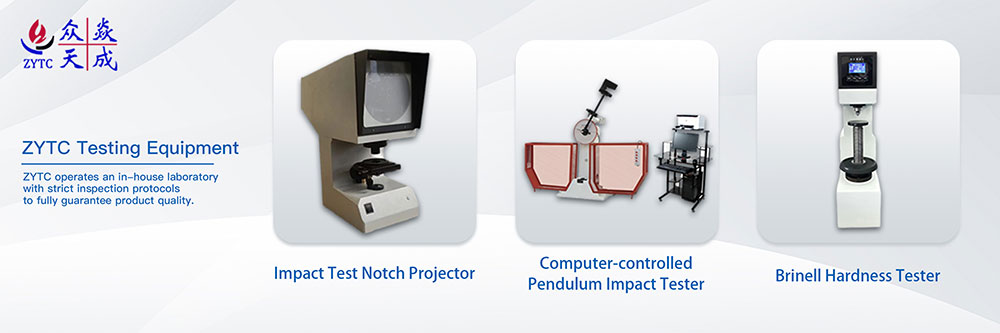
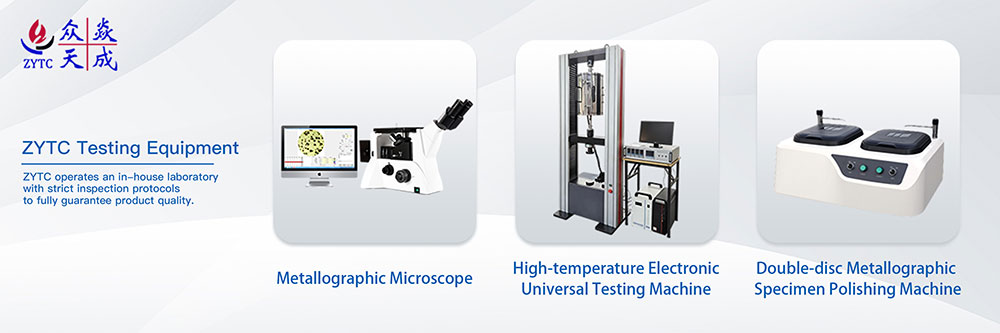
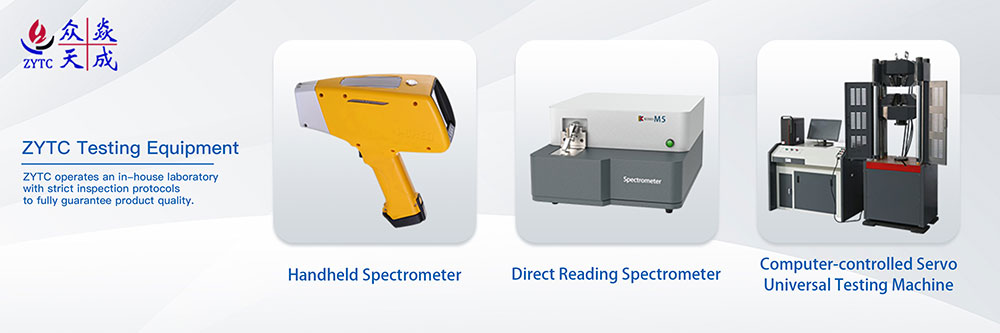
- In-House Lab Verification:
- Metallurgical Microscopy: We cross-section the tubes to verify wall thickness uniformity and inspect the inner bore for micro-scratches or imperfections.
- Direct Reading Spectrometer: 100% chemical verification of every melt to ensure precise alloy composition.
- Mechanical Testing: Universal testing machines to validate tensile strength and yield characteristics.
- Surface Finishes: We offer electropolishing to achieve the ultra-smooth inner bores (Ra 0.01) and bright finishes required for implantable devices.
Conclusion
Specifying medical alloy tubes is about controlling the microscopic details—inner wall finish, concentricity, and inclusion cleanliness. By selecting the right alloy and partnering with a supplier that verifies these critical parameters in-house, you can ensure your minimally invasive devices perform flawlessly in the clinic.
Ready to prototype or scale your production?
ZYTC Alloy provides custom medical tubing solutions, from prototype runs to full-scale production. Send us your specifications (OD, ID, Wall Thickness, Alloy, and Surface Finish) for a technical review and quote.
📧 Email: daisy@zytcsteel.com
📱 WhatsApp/WeChat: +86 17335753350