
The design problem on a modern catheter is always the same conversation: pushability versus lumen, wall thickness versus outer profile, fatigue life versus cost. Cold-drawn 316L carries most of that load comfortably. It stops carrying it when the profile gets thin enough that the wall has to be shaved below what 316L strength can hold.
That is the point at which cobalt-chromium alloys enter the comparison. This article covers one of them — Elgiloy (UNS R30003, Phynox, W.Nr 2.4711, 3J21) — where it fits against MP35N and L605, and when it is still cheaper to stay on 316L. The dimensional catalogue for our own tubing sits on the Elgiloy micro tubing product page; this article is about the selection decision that comes before the specification.
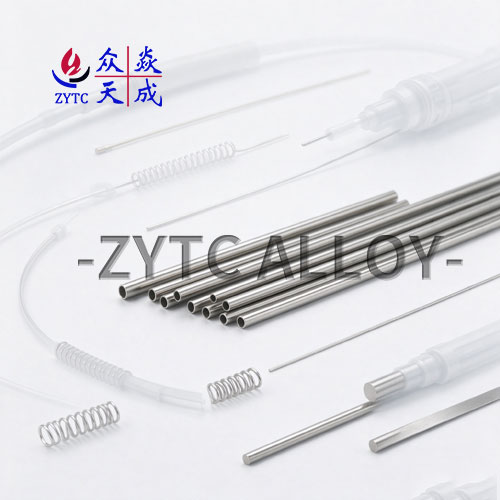

What Elgiloy actually is
Elgiloy is a wrought cobalt-chromium-nickel-molybdenum-iron alloy specified under ASTM F1058 and ISO 5832-7 for surgical implant components. Its value is not a single record-breaking property: it combines high strength after cold work and aging, a near-constant elastic modulus over temperature, good physiological corrosion resistance, and a non-magnetic base state.
Its strength only appears in the right condition. Annealed Elgiloy is a soft, formable alloy; the high-tensile numbers people cite belong to the spring-temper-plus-aged condition, which is aged after coiling or drawing at roughly 527 °C for about five hours. An order that says only “Elgiloy” without the condition does not specify which of those two products it wants.
The strength margin, and what it buys in the catheter
The reason engineers move to Elgiloy in thin-wall tubing is a tensile-strength comparison, but the numbers depend heavily on form and condition, and they should not be quoted loosely.
| Material and condition | Tensile strength | Note |
|---|---|---|
| Elgiloy, spring temper + aged, wire / small tubing | ~1,790–2,275 MPa | Strength after aging from cold-worked spring temper |
| Elgiloy, spring temper + aged, strip | Up to ~2,600 MPa | Upper bound belongs to strip, not small-diameter tubing |
| Elgiloy, annealed | ~830–1,035 MPa | Formable condition, before strength is developed |
| 316L, hard-drawn micro tubing | ~1,000 MPa | The baseline most catheter shafts still use |
The design translation is straightforward. Under the same burst-pressure and kink-resistance requirement, a stronger alloy can carry the load with a thinner wall, and a thinner wall gives a larger lumen inside the same outer diameter. For an aspiration catheter that means more cross-sectional area for negative pressure; for a guidewire lumen it means smoother guidewire passage; for a neurovascular shaft it means a distal section that can stay flexible while the proximal section keeps pushing torque.
Where precise comparisons are needed, test against your own geometry and condition. The tensile numbers above are datasheet ranges, not a substitute for a lot-specific certificate, and any quoted comparison should name the sample diameter, delivery condition and test standard.
Beyond strength: the three properties that decide the part
Fatigue life under cyclic bending
A delivery system that flexes through tortuous anatomy is a fatigue problem before it is a strength problem. Elgiloy’s cold-worked and aged condition retains high fatigue resistance over repeated bending, which is why it turns up in valve and occluder delivery systems and in small precision springs. The fatigue margin matters more than peak tensile for any part that cycles for the life of the device.
Constant modulus with temperature
Elgiloy belongs to the Elinvar family: its elastic modulus moves little across the operating temperature range where a stainless spring or shaft would drift. For a precision component whose stiffness is part of the device’s tuning, that stability means the calibration does not shift between a cold procedural room and body temperature.
Non-magnetic base state — and the MR qualification that still follows
Elgiloy is a non-magnetic cobalt-chromium alloy. That matters in MR-guided procedures and post-operative MRI follow-up: a ferromagnetic component would move or generate artefacts in the field. The distinction that should not be blurred is that non-magnetic is a material precondition, not an MRI safety verdict. Final displacement, heating and artefact behaviour still have to be qualified on the finished device under the applicable MR compatibility standard.
Inner bore finish and continuous length
In a micro catheter, lumen roughness sets guidewire friction and blood retention as much as material choice. Our Elgiloy tubing can be drawn and electropolished to a target inner-bore roughness of Ra 0.01 µm, verified per lot, and supplied as a single continuous length up to 2,000 mm without a mid-assembly weld or splice. Both features reduce failure points along the lumen; the actual finish should be agreed as a per-lot inspection item rather than assumed from the alloy alone.
Elgiloy against the other cobalt alloys
When the decision leaves 316L, the comparison is usually among three cobalt families. They are not interchangeable.
| Alloy | Decisive property | Typical role |
|---|---|---|
| Elgiloy R30003 | High fatigue, constant modulus, non-magnetic | Precision shafts, springs, small-bore fatigue-critical tubing |
| MP35N micro tubing | Highest cyclic fatigue strength, corrosion resistance | Pacing and neurostimulation leads, implantable high-cycle parts |
| L605 micro tubing | Radiopacity, balloon-expandable tolerance | Stent delivery shafts, balloon catheter components, visible markers |
MP35N pushes fatigue strength further for implantable cyclic loads; L605 trades some strength for X-ray visibility and balloon-forming behaviour. Elgiloy sits where fatigue life and stable modulus matter together, and where a spring-like precision component is the end part. For a wider read on the MP35N side, see the article on MP35N for medical devices.
When 316L is still the right answer
Elgiloy earns its cost only when the profile constraint is real. If the wall has room, if the device does not cycle heavily, and if the budget is being watched, 316L remains the cheaper, more familiar choice with a deeper supply chain.
The switch becomes justified when one or more of these is true: the wall cannot reach the required lumen in 316L at the target outer diameter; the component survives repeated bending in service; stiffness has to stay stable over temperature; or the device needs a non-magnetic base condition for MR-adjacent use. A design that meets none of these is buying cobalt strength it does not use.
What to put on the purchase order
- Grade and aliases: Elgiloy / UNS R30003 / Phynox / W.Nr 2.4711 / 3J21, against ASTM F1058 and ISO 5832-7.
- Condition: spring temper plus aged, with the aging cycle stated; annealed stock is a different product.
- Geometry: OD, ID, wall and length, each with its own tolerance; our range is OD 0.13–3.0 mm, ID 0.08–2.0 mm, continuous length up to 2,000 mm.
- Finish: inner Ra target, surface treatment (bright, electropolished, or black oxide), and the inspection method for bore roughness.
- Documentation: EN 10204 3.1 certificate with measured chemistry, dimensions and the relevant mechanical data per heat.
For the assembly-level view across stainless, cobalt and nitinol tubing, the earlier guide to medical alloy tubes for minimally invasive devices covers the catheter design context.
Common questions
Is Elgiloy non-magnetic?
In its base material condition Elgiloy is non-magnetic, which is a precondition for MR-adjacent components. The finished device still requires MR compatibility testing for displacement, heating and artefact; the alloy alone does not certify MR safety.
What is the difference between Elgiloy and MP35N?
Both are cobalt-based, high-fatigue alloys. MP35N is typically chosen for implantable leads and parts under the highest cyclic load; Elgiloy is chosen where a stable elastic modulus and spring-like precision matter together, including small precision shafts and springs.
Does Elgiloy tubing meet ASTM F1058?
Yes. R30003 is specified under ASTM F1058 and ISO 5832-7 for wrought cobalt-chromium-nickel-molybdenum surgical alloy. The certificate should state the condition and measured values rather than a generic “complies”.
What sizes of Elgiloy micro tubing are available?
Our standard capability covers OD 0.13–3.0 mm and ID 0.08–2.0 mm in continuous lengths up to 2,000 mm, with centerless grinding, electropolishing, laser cutting and heat treatment available as custom services.
Request a datasheet
Send the OD/ID/wall, condition, finish target and intended device. We will return a datasheet with the available strength range, lot-testing details and the documentation pack for an evaluation sample. Start from the Elgiloy micro tubing product page, or compare the adjacent MP35N and L605 grades before deciding.
📧 Email: daisy@zytcsteel.com
📱 WhatsApp/WeChat: +86 17335753350