
In the design of orthopedic implants, surgical instruments, and dental prosthetics, the choice of raw material is the single most critical factor determining the device’s safety, lifespan, and manufacturing cost.
While many engineers are familiar with the standard grades—such as Ti-6Al-4V, 316LVM, or CoCrMo—procuring “medical-grade” alloy bars requires a far more rigorous approach than buying standard industrial metals. The difference between a standard bar and a medical bar lies in melt cleanliness, traceability, and precise mechanical consistency.
In this guide, we break down the essential engineering considerations when specifying Medical Alloy Bars, and how partnering with the right supplier mitigates your manufacturing risks.
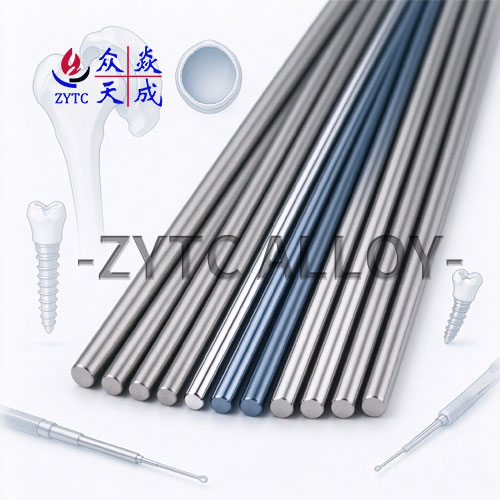
Part 1: The “Big Three” Medical Alloy Bars
When selecting materials for implantable devices or surgical tools, three material families dominate. Here is how to choose:
1. Titanium Alloys (Ti-6Al-4V ELI – Grade 23)
- The Advantage: Excellent biocompatibility, high strength-to-weight ratio, and a low elastic modulus that closely mimics human bone (reducing “stress shielding”).
- The Challenge: Titanium is highly reactive and prone to galling during machining. Specifying the ELI (Extra Low Interstitial) grade is mandatory for implants to ensure maximum ductility and fracture toughness.
2. Cobalt-Chromium Alloys (CoCrMo – ASTM F75 / F1537)
- The Advantage: Unmatched wear resistance and hardness. It is the gold standard for articulating joint surfaces, such as femoral heads and acetabular cups.
- The Challenge: CoCrMo is notoriously difficult to machine. Whether you need cast (F75) or wrought (F1537) bars, the carbide distribution must be tightly controlled to prevent tool breakage and micro-cracking.
3. Medical Stainless Steels (316LVM – ASTM F138)
- The Advantage: Cost-effective, excellent corrosion resistance, and good formability.
- The Challenge: 316LVM must be produced via Vacuum Arc Remelting (VAR) to reduce sulfur and non-metallic inclusions. This is critical for avoiding pitting corrosion in the human body.
Part 2: The “Hidden” Supply Chain Risks
Even if a supplier provides a certificate stating “ASTM F136 compliant,” the actual performance of the alloy bar can still fail during machining or sterilization. Here is what engineers need to verify:
- Grain Size & Microstructure: For titanium and CoCrMo bars used in forging (like hip stems), a uniform, fine-grain microstructure is required to ensure proper fatigue life. Poorly processed bars can lead to catastrophic failure under cyclic loading.
- Inclusion Content: Microscopic non-metallic inclusions (like oxides or sulfides) act as stress concentrators. A clean melt is just as important as the chemical formula.
- Surface Integrity: Medical bars often require a defect-free, decarburized-free surface. Peeling or grinding marks that are too deep can become crack initiation sites.
Part 3: Choosing the Right Supplier (It’s More Than Just a Sales Office)
When sourcing from overseas manufacturers—particularly from China—the “certificate of analysis” (CoA) is not enough. You need a supplier with in-house metallurgical verification.
How ZYTC Alloy Supports Medical Device Manufacturers
As a leading Chinese supplier of medical-grade alloy bars, ZYTC Alloy operates with a fully equipped in-house laboratory. We don’t just pass along mill certificates; we verify the material at the source.
- 100% Chemical Verification: Using Direct Reading Spectrometers to ensure precise chemistry, including trace elements that affect biocompatibility and machining.
- Mechanical Testing: Universal Testing Machines verify tensile and yield strength at specified heat treatments.
- Metallurgical Analysis: Microscopy confirms grain size (ASTM E112) and inclusion ratings (ASTM E45), ensuring the material is fit for forging and machining.
Available Forms for Medical Manufacturing:
ZYTC supplies premium medical alloy bars in:
- Ti-6Al-4V ELI (Grade 23)
- CoCrMo (Cast & Wrought)
- 316LVM Stainless Steel
- Custom-cut lengths and centerless-ground finishes upon request.
Conclusion
Specifying medical alloy bars is a balancing act between biocompatibility, machinability, and lifecycle cost. By understanding the metallurgical nuances and partnering with a supplier that provides full traceability and in-house verification, you can ensure your medical devices are built on a foundation of absolute material integrity.
Have a specific medical alloy requirement?
Send your material specifications (Grade, Diameter, Tolerance, and Application) to our technical team. We provide competitive quotes with full material certification and third-party inspection support.
📧 Email: daisy@zytcsteel.com
📱 WhatsApp/WeChat: +86 17335753350