
In the world of medical device manufacturing, choosing the right material is a matter of life and death. When it comes to stainless steel, 316L and 316LVM are two of the most common grades specified in engineering drawings.
At first glance, their chemical compositions seem almost identical. However, the difference in their manufacturing processes—and the resulting microstructural purity—is massive. For engineers and procurement managers, understanding this distinction is critical when designing surgical instruments versus long-term implantable devices.
At ZYTC Alloy, we supply both grades, and we are here to break down the technical differences to help you make the right choice.

What is 316L Stainless Steel?
316L (UNS S31603) is a low-carbon version of the standard 316 stainless steel. The “L” stands for “Low Carbon” (typically max 0.03%). It is an austenitic stainless steel containing molybdenum (2-3%), which significantly improves its resistance to pitting and crevice corrosion in chloride environments (like human blood and bodily fluids).
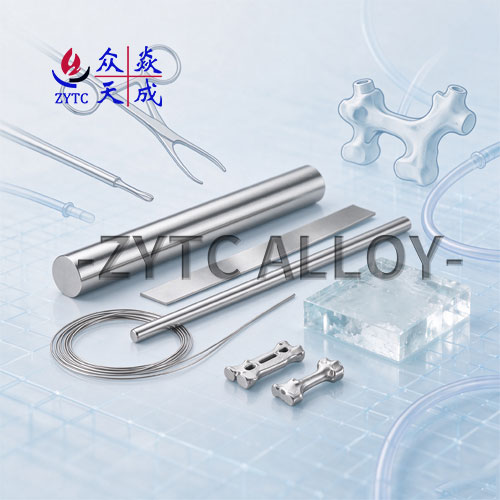
316L is widely used for surgical instruments, medical trays, and non-implantable device housings. It is typically melted using standard Electric Arc Furnace (EAF) or Air Melting techniques, followed by Argon Oxygen Decarburization (AOD).
What is 316LVM Stainless Steel?
316LVM (UNS S31673) stands for “Low Carbon, Vacuum Melted”. While the base chemistry is similar to 316L, 316LVM is specifically designed for implantable medical devices and must meet the stringent requirements of ASTM F138 (Standard Specification for Wrought 18Chromium-14Nickel-2.5Molybdenum Stainless Steel Bar and Wire for Surgical Implants).
The key differentiator is the melting process. After the initial air melting, 316LVM undergoes Vacuum Arc Remelting (VAR) or Vacuum Induction Melting (VIM). This secondary vacuum melting process removes dissolved gases (like hydrogen and nitrogen) and significantly reduces non-metallic inclusions (such as sulfides and oxides). The result is a much “cleaner” steel with superior micro-cleanliness, which is essential for preventing fatigue failure and adverse tissue reactions in the human body.
Key Differences: 316L vs. 316LVM
| Feature | 316L Stainless Steel | 316LVM Stainless Steel |
|---|---|---|
| Melting Process | Air melting (AOD) | Air melting + Vacuum Remelting (VAR/VIM) |
| Standard | ASTM A240, ASTM A276 | ASTM F138, ASTM F139 |
| Micro-cleanliness | Standard | Ultra-high (Low inclusion content) |
| Primary Application | Surgical tools, equipment | Orthopedic implants, temporary implants |
| Cost | Cost-effective | Premium (due to secondary processing) |
Which One Should You Choose for Medical Implants?
Rule of Thumb: If the component will be permanently or temporarily implanted inside the human body (e.g., bone screws, fracture plates, intramedullary nails, or vascular stents), you must use 316LVM (ASTM F138).
The strict limits on non-metallic inclusions in 316LVM are necessary because inclusions can act as stress concentrators, leading to premature fatigue cracks under the cyclic loading of human movement. Furthermore, the higher purity reduces the risk of localized corrosion that could release metal ions into the body.
If the device is a surgical instrument (e.g., forceps, retractors, scalpel handles) or external medical equipment, 316L is generally more than sufficient and more cost-effective.
How ZYTC Alloy Ensures Material Quality: Inside Our In-House Laboratory
Even with the correct grade specified on paper, the actual quality of the material depends entirely on the supplier’s process control. A “certificate of conformity” means very little if the supplier lacks the facility to verify it.
This is where ZYTC Alloy’s in-house laboratory becomes your competitive advantage. As a dedicated Chinese medical alloy supplier, we do not rely solely on mill certificates; we physically verify the materials we ship:
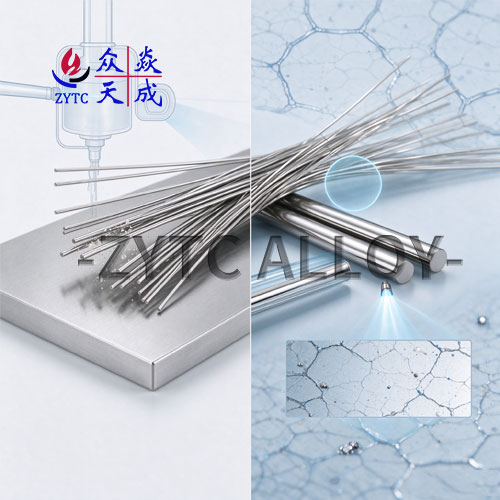
- Optical Emission Spectroscopy (OES): We utilize our in-house spectrometer to verify that the chemical composition (Cr, Ni, Mo, and Carbon limits) strictly meets ASTM F138 requirements.
- Metallurgical Microscopy: Our lab is equipped with advanced metallurgical microscopes to examine grain size and evaluate non-metallic inclusion ratings (crucial for 316LVM).
- Mechanical Testing: We validate tensile strength, yield strength, and elongation to ensure the material is in the optimal delivery state (annealed or cold-worked) for your machining processes.
- Tight Tolerance Control: Our integrated drawing and shaping lines ensure that 316LVM fine wires and bars meet the exact micro-dimensions required for complex medical assembly.
Partner with ZYTC Alloy for Implant-Grade Stainless Steel
Whether you need 316LVM bars for orthopedic implant machining or fine 316L wires for catheter braiding, ZYTC Alloy has the inventory, the processing capability, and the quality assurance you need.
Every batch of our implant-grade 316LVM is supplied with a comprehensive EN 10204 3.1 Material Test Report (MTR), detailing the full traceability from the vacuum melt to the finished wire.
Contact Our Technical Team
Need help selecting the right stainless steel grade or want to review our laboratory testing capabilities? Reach out to us today.
📧 Email: daisy@zytcsteel.com
📞 Phone/WhatsApp: +86 17335753350