
Elgiloy UNS R30003 Micro Tubing for Neurovascular & Structural Heart Catheters
When a neurovascular micro catheter kinks in the cavernous segment, or an aspiration catheter loses negative pressure because the wall had to be thickened to survive the curve, the limiting factor is usually the same: the micro tubing material ran out of strength before the design ran out of space. Cold-drawn 304 and 316L stainless steel micro tubing—the default for decades—reaches its practical ceiling at roughly 1000 MPa tensile strength. Beyond that point, engineers are forced to trade lumen for wall thickness, or flexibility for pushability.
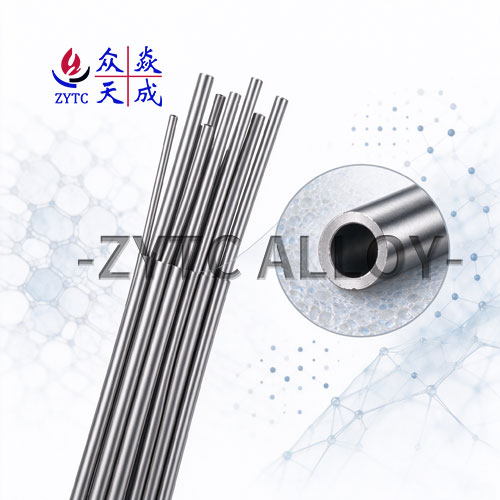
ZYTC’s medical-grade Elgiloy® (UNS R30003 / Phynox / 3J21) seamless micro tubing is engineered for exactly that ceiling. In the cold-worked and aged condition, Elgiloy reaches tensile strength up to 2600 MPa—more than double that of 316L stainless steel—allowing thinner walls, smaller profiles, and greater resistance to kinking and fatigue in the most tortuous anatomical pathways.

Why Elgiloy Instead of 316L Stainless Steel?
The decision is rarely “which material is better” in the abstract. It is “at what point does 316L stop working.” The comparison below summarizes where that point sits for micro tubing in minimally invasive devices.
| Property | Elgiloy UNS R30003 (cold-worked + aged) | 316L Stainless Steel (cold-drawn) | Design implication |
|---|---|---|---|
| Tensile strength | Up to ~2600 MPa | ~1000 MPa | Thinner wall for the same pressure/kink requirement |
| Magnetic behavior | Non-magnetic | Weakly magnetic (varies with cold work) | Safer under MRI guidance and follow-up |
| Fatigue resistance | High | Moderate | Suitable for cyclic physiological loads (delivery systems, valve frames) |
| Corrosion resistance in physiological media | Excellent | Good | Long-term implantable and surgical instrument components |
| Inner bore finish (ZYTC capability) | Ra 0.01 µm | Typically higher | Lower friction, reduced thrombus risk in micro-cannulas |
If your design is not constrained by wall thickness or outer profile, 316L remains the cost-effective choice. The switch to Elgiloy becomes justified when the device must navigate extreme tortuosity, when every 0.02 mm of wall thickness matters, or when non-magnetic behavior under MRI is a hard requirement rather than a preference.
Ultra-Fine Tubing Capabilities for Medical Design
Navigating micro-vessels requires extreme precision. Our advanced cold-drawing and finishing processes push the boundaries of micro-manufacturing:
-
Micro-Dimensions: Outer Diameter (OD) from 0.13 mm to 3.0 mm, Inner Diameter (ID) from 0.08 mm to 2.0 mm.
-
Ultra-Smooth Inner Bore (Ra 0.01 µm): Critical for preventing thrombus formation in micro-cannulas, ensuring smooth passage of guidewires, and maintaining precise fluid delivery.
-
Extended Continuous Lengths: Single-piece lengths up to 2000 mm. By eliminating mid-assembly joints, we help you reduce failure points, improve torque transmission, and simplify device assembly.
-
Fully Customizable: Tapering, flaring, laser cutting, and specific heat treatments (e.g., spring temper) are available to match your exact device design.
Medical-Grade Standards & Biocompatibility
Elgiloy® is a proven material in the medical field, widely recognized for its reliability in implantable and surgical instruments.
-
Compliance: Manufactured to meet ASTM F1058 (Wrought Cobalt-Chromium-Nickel-Molybdenum Alloy for Surgical Implants) and ISO 5832-7 standards.
-
Non-Magnetic: Maintains non-magnetic properties, making it ideal for devices used under MRI guidance.
-
Biocompatibility: Excellent corrosion resistance in physiological environments, minimizing adverse tissue reactions.
-
Fatigue Resistance: High fatigue strength essential for devices subject to millions of cyclic physiological loads (e.g., vascular stents, heart valves, delivery systems).
Technical Specifications
| Parameter | Capability Range | Notes |
|---|---|---|
| Material | Elgiloy® / UNS R30003 / Phynox / 3J21 | Medical-grade Cobalt-Chromium alloy |
| Outer Diameter (OD) | 0.13 mm – 3.0 mm | Precision drawn for micro-catheters |
| Inner Diameter (ID) | 0.08 mm – 2.0 mm | Wall thickness uniformity guaranteed |
| Inner Wall Roughness | Ra 0.01 µm | Minimizes friction & thrombus risk |
| Max Length | 2000 mm | Continuous length, joint-free |
| Custom Services | Centerless grinding, electropolishing, laser cutting, heat treatment | Available upon request |
Critical Medical Applications
Our ultra-fine Elgiloy® tubing is engineered for the most demanding clinical environments:
-
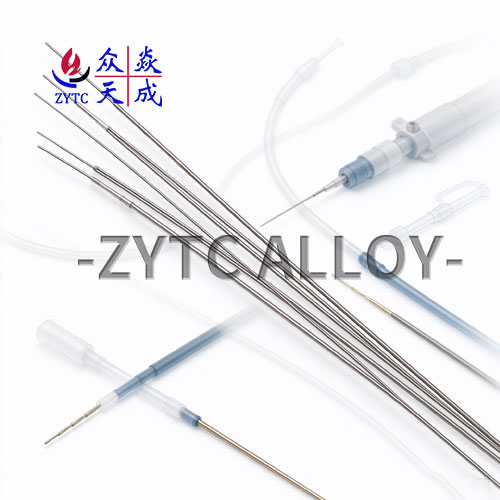
Neurovascular & Cardiovascular: Micro-catheters, aspiration tubing, delivery sheaths, and guidewire hypotubes.
-
Structural Heart: Delivery systems for occluders and heart valve frames.
-
Surgical Instruments: Biopsy needles, ophthalmic cannulas, and micro-surgical fluidics.
-
Implantable Devices: Components requiring long-term non-magnetic and corrosion-resistant performance.
Quality Assurance: In-House Medical Grade Laboratory
To guarantee the flawless inner bore and exact dimensions of our micro-tubing, ZYTC operates a fully equipped in-house laboratory. Every batch of medical Elgiloy® tubing undergoes rigorous quality control:
-
Metallurgical Microscopy: To verify wall thickness uniformity and inspect the inner bore for micro-defects.
-
Direct Reading Spectrometer: For 100% chemical composition verification of the raw Cobalt-Chromium alloy.
-
Mechanical Testing: Ensuring the tubes meet required tensile and yield strength standards.
Start Your Custom Medical Order
Whether you need a prototype run for a new medical device design or a bulk order for production, ZYTC provides the technical expertise and quality assurance you need.
To request a quote, please provide:
-
Outer Diameter (OD) and Inner Diameter (ID) with tolerances.
-
Required Length (Max up to 2000 mm).
-
Surface finish requirements (e.g., Ra 0.01 standard).
-
Heat treatment condition.
-
Quantity (meters or kilograms).
📧 Email: daisy@zytcsteel.com
📱 WhatsApp/WeChat: +86 17335753350