
ASTM F1537 Alloy 1 (UNS R31537) is the medical-grade version of wrought cobalt-28chromium-6molybdenum alloy. Its chemistry is similar to cast ASTM F75, but the manufacturing path is entirely different: forging/warm working eliminates casting porosity, refines grain structure, and significantly improves toughness and fatigue resistance. For implant components subjected to cyclic loading — bone plates, intramedullary nails, joint attachments — this difference is the deciding factor in material selection.
The warm-worked condition further pushes tensile strength to ≥1172 MPa and yield strength to ≥827 MPa, while maintaining ≥12% elongation — a strength-ductility combination that annealed (897 MPa / 517 MPa / 20%) and hot-worked (1000 MPa / 700 MPa / 12%) conditions cannot simultaneously achieve.
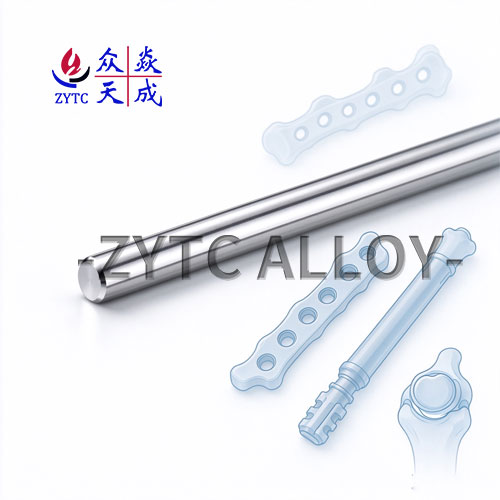

F1537 Alloy 1 warm-worked bar fits your application when:
-
The component carries dynamic loads (orthopedic fixation, joint attachments, micro drive shafts) and fatigue life is a design constraint;
-
You need a balance of high strength and good ductility, not hardness alone;
-
Downstream operations involve precision CNC turning, grinding, or polishing, with requirements on dimensional stability and surface quality;
-
The material must meet ISO 5832-12 or ASTM F1537 medical-grade certification requirements.
Consider other options when:
-
The part geometry is complex and cannot be machined from bar, and volume favors casting — F75 cast alloy is more cost-effective;
-
Design strength requirements are modest (<800 MPa) and wear resistance is the primary driver — high-carbon F1537 Alloy 2 may offer a better carbide distribution;
-
You need the higher strength or tighter tolerances of a cold-drawn condition — warm working and cold working are distinct conditions and must be specified separately.
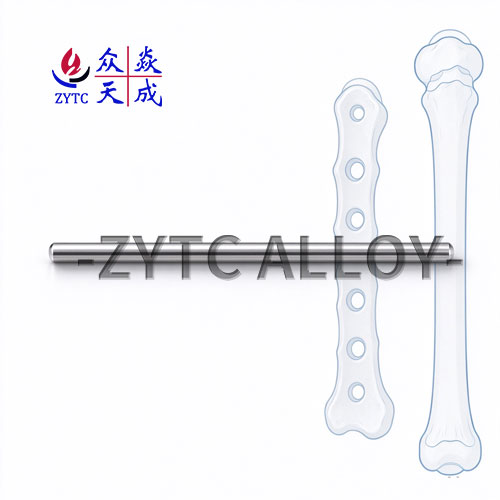
Specifications & Tolerances: Ø3.50mm × 3000mm, h9
This specification on your page deserves standalone explanation, because it reflects the actual procurement logic for medical precision bar.
| Item | Parameter |
|---|---|
| Diameter | Ø3.50 mm |
| Length | 3000 mm (cut-to-length available) |
| Tolerance class | h9 (3.49–3.50 mm) |
| Condition | Warm worked |
| Surface | Per medical-grade requirements (ground/polished optional) |
What h9 tolerance means: This is a unilateral minus tolerance — upper deviation zero, lower deviation −0.01 mm. For downstream Swiss-type or automatic lathe machining, this means bar OD consistency directly determines chucking repeatability and feed stability. If your process relies on bar OD as a datum (rather than re-setting tools per part), h9 is a more appropriate choice than a general tolerance (e.g., ±0.05 mm).
Procurement note: ISO 5832-12 mechanical property requirements apply to bar, rod, and wire. Properties measured from finished parts may differ from specification values. When ordering, explicitly require that “MTC property data originate from specimens taken from the bar itself,” not merely from finished-part sampling.
Warm-Worked vs. Cast F75: Microstructure Determines Service Performance
Wrought F1537 and cast F75 share similar chemistry ranges (Cr 26–30%, Mo 5–7%, balance Co), but the manufacturing path creates microstructural differences that directly affect component life.
Cast F75: Molten metal poured into a mold solidifies with unavoidable micro-shrinkage porosity and dendritic segregation. These defects become crack initiation sites under cyclic loading.
Wrought F1537 (warm worked): Thermomechanical processing breaks down the cast structure — porosity is welded shut, grains are refined to ASTM No. 5 or finer, and carbides are more uniformly distributed. Published Carpenter data indicate that warm-worked F1537 Alloy 1 typically achieves approximately 150 ksi yield and 199 ksi tensile, with fatigue performance significantly better than annealed + cold-drawn conditions.
Design implication: If your implant component must sustain cyclic stress over the long term (e.g., a bone plate subjected to repeated bending under walking loads), casting porosity in F75 is a potential failure site; the microstructural uniformity of wrought F1537 provides a higher safety margin.
Processing Notes: Three Details That Affect Yield
Q1: How does machining warm-worked bar differ from annealed?
Warm-worked condition has higher hardness than annealed (typically ~44 HRC vs. lower for annealed), requiring greater cutting force. Use sharp carbide tooling and avoid tool rubbing on the surface — the work-hardening tendency of CoCrMo means a dull edge generates a hardened layer on the machined surface, and the next cut’s depth must penetrate that layer or tool wear accelerates sharply. When Swiss-machining Ø3.5mm fine bar, rigid clamping and adequate coolant matter more than chasing high spindle speeds.
Q2: What should I watch for in grinding and polishing?
CoCrMo has low grinding thermal conductivity, concentrating heat at the contact zone. Avoid grinding burn — a burned layer creates tensile stress at the implant surface, negating the fatigue advantage of the wrought process. Use softer-grade wheels, ample coolant, and light cutting parameters, and verify surface integrity after grinding (e.g., acid etch or microhardness gradient).
Q3: Is post-processing heat treatment required?
No. The warm-worked condition is the final supply condition; its mechanical properties come from thermomechanical processing, not from subsequent aging. Annealing or solution treating the bar would lose the dislocation strengthening introduced by warm working, dropping strength back to annealed levels (897 MPa). Do not heat treat warm-worked bar “to relieve stress” unless you can accept the property degradation and re-qualify the material.
Inspection & Certification: Minimum Requirements for Medical-Grade Procurement
The certificate list on your page is a reasonable starting point. On top of it, buyers should specify the following three items on the PO:
1. Heat number traceability
The MTC must be linked to the original melt heat number, not merely state “conforms to ASTM F1537.” Medical alloy traceability requires tracing from finished part back to bar heat lot, and from there to melting records.
2. Grain size report
ASTM F1537 requires average grain size of ASTM No. 5 or finer. Require the supplier to include grain size results in the MTC (per ASTM E112 or ISO 643), not merely a statement of “standard compliance.”
3. Optional NDT — with a caveat
Your page lists UT/MT as available. For Ø3.5mm fine bar, ultrasonic inspection has limited applicability (probe size and coupling constraints). If a customer specifies UT, confirm the probe frequency and inspection standard the supplier uses are suitable for that diameter. Magnetic particle inspection is not applicable to cobalt-based alloys (non-ferromagnetic) — unless the customer has a specific rationale, MT should not appear on the routine inspection list for CoCrMo bar.
Why Source From ZYTC Alloy
-
Condition clarity: Supplied in warm-worked condition; MTC properties are from bar-body specimens, not mixed with annealed or hot-worked data.
-
Dimensional capability: Ø3.50mm × 3000mm in stock, h9 tolerance delivered consistently; cut-to-length and other diameters available (Ø2.00–110.00 mm range).
-
Medical testing coordination: Third-party testing can be arranged per customer requirements (chemistry re-verification, mechanical re-testing, metallography, grain size), with cost and lead time stated in the quotation.
-
Certification: ISO 9001; complete traceability documentation packages available for medical-grade orders.
-
Lead time: 7–10 days for standard sizes; 3–4 weeks for non-standard sizes or orders requiring third-party testing.
Request a Quote or Technical Support
Please specify: governing standard (ASTM F1537 / ISO 5832-12), alloy (Alloy 1/2), condition (warm-worked/annealed/hot-worked), diameter and tolerance, length, surface requirements, and inspection items (MTC/grain size/third-party).
📧 daisy@zytcsteel.com
📲 WhatsApp: +86 17335753350