
ZYTC Alloy is a professional Chinese supplier of premium medical-grade Nitinol. Our ASTM F2063 wrought nickel-titanium alloy is engineered for the fabrication of high-performance surgical implants and minimally invasive medical devices, trusted by global medical component manufacturers.
ASTM F2063 Nitinol — Verified Transformation Temperature, Not Just a Chemistry Certificate
Nitinol’s clinical performance is governed by its austenite finish temperature (Af) — not by its nickel percentage alone. Two wires with identical chemistry can behave as different materials if their Af points diverge. ZYTC Alloy supplies ASTM F2063 wrought Nitinol (wire, bar, strip, tubing) with batch-specific Af verification and superelastic testing per ASTM F2516, so the material you receive performs in the condition your device design assumes.
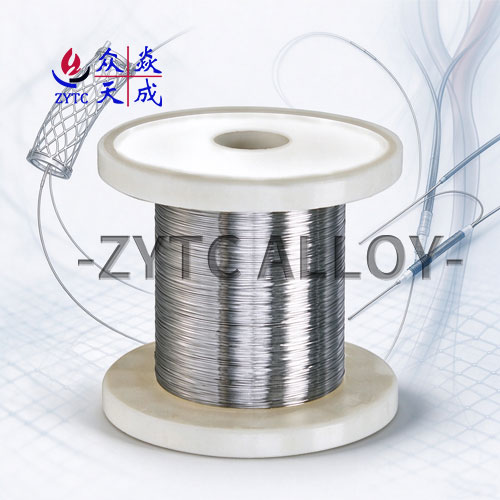

Which State Do You Need: Superelastic or Shape Memory?
Nitinol is specified for its functional behavior, not its strength. The same ASTM F2063 chemistry can be processed into two distinct states:
| Functional State | Behavior | Typical Af | Medical Application |
|---|---|---|---|
| Superelastic | Recovers 8–10% strain upon unloading at body temperature | Below ~20°C (full austenite at use) | Guidewires, self-expanding stents, kink-resistant catheters |
| Shape Memory | Returns to preset shape when heated above Af | Tunable (~30°C for body-temperature activation) | Deployable implants, embolic protection devices, actuators |
Selection note: For a guidewire that must remain austenitic and kink-resistant during navigation, specify superelastic wire with Af below room temperature. For a self-expanding stent that is crimped in martensite and deploys at body temperature, the Af point must be tuned to sit just below 37°C — typically around 30°C . The nickel content is adjusted within the ASTM F2063 window (54.5–57.0%) to shift Af accordingly; higher nickel lowers the transformation temperature.
Chemical Composition (ASTM F2063)
| Element | Specification (wt.%) |
|---|---|
| Nickel (Ni) | 54.5–57.0 |
| Titanium (Ti) | Balance |
| Carbon (C) | 0.050 max. |
| Oxygen (O) | 0.050 max. |
| Nitrogen (N) | 0.005 max. |
| Hydrogen (H) | 0.005 max. |
| Iron (Fe) | 0.050 max. |
| Copper (Cu) | 0.010 max. |
| Chromium (Cr) | 0.010 max. |
Why the interstitial limits matter: Oxygen and carbon control inclusion content and affect transformation sharpness. A certificate showing only Ni and Ti is incomplete for medical device validation.
Key Physical Properties (Reference Values)
| Property | Austenite | Martensite |
|---|---|---|
| Density | ~6.45 g/cm³ | ~6.45 g/cm³ |
| Modulus of Elasticity | 75–83 GPa | 28–41 GPa |
| Electrical Resistivity (20°C) | ~0.82 µΩ·m | ~0.76 µΩ·m |
| Thermal Conductivity (20°C) | ~18 W/m·K | ~9 W/m·K |
| Thermal Expansion (20°C) | ~11 ×10⁻⁶/K | ~6.6 ×10⁻⁶/K |
Values depend on thermomechanical processing and heat treatment. Confirm against your specific batch data.
Core Advantages
✅ Unique superelasticity for large reversible deformation
✅ Reliable shape memory effect for deployable implant structures
✅ Manufactured to ASTM F2063 for surgical implant use
✅ Tightly controlled metallurgical cleanliness and composition
✅ Available in multiple delivery states: annealed, cold worked, heat treated
✅ Suitable for precision processing of miniature medical components
Applications
– Self-expanding vascular stents
– Medical guidewires
– Orthodontic archwires
– Vena cava filters
– Minimally invasive surgical instruments
– Miniature biomedical actuators
Supply Capability from ZYTC Alloy
As a dedicated Chinese medical alloy supplier, ZYTC Alloy supplies ASTM F2063 Nitinol in bar, flat rolled strip and tubing forms. We offer custom sizes, tailored heat treatment and surface finishes to match your medical device drawings. Full material test certificates are available to support medical device validation and audit requirements.
Need ASTM F2063 Nitinol or other medical specialty alloys? Send your inquiry today!
daisy@zytcsteel.com
+86 17335753350