
In material selection for orthopedic implants and surgical instruments, 316LVM (1.4441) has long dominated. However, as high-load implant applications place greater demands on strength, corrosion resistance, and fatigue life, nitrogen-strengthened austenitic stainless steel—especially 1.4472 (UNS S31675), which complies with ASTM F1586—is becoming an increasingly attractive upgrade option. As a professional medical alloy supplier in China, ZYTC Alloy offers a full range of 1.4472 products from annealed to cold-worked conditions, serving global implant manufacturers’ need for stable access to high-performance materials.

What Is ASTM F1586 1.4472?
ASTM F1586 is the standard specification for wrought nitrogen-strengthened 21 chromium-10 nickel-3 manganese-2.5 molybdenum stainless steel alloy bar for surgical implants. The corresponding material designation is UNS S31675, the European material number is 1.4472, and it is commonly known commercially as Rex 734 or M30NW. Its chemical composition is characterized by high chromium (19.5–22%), high nitrogen (0.25–0.5%), and molybdenum (2–3%), with manganese controlled at 2.00–4.25% to increase nitrogen solubility. Compared with 316LVM, 1.4472 has a higher chromium content, and nitrogen, as a strong interstitial alloying element, replaces part of nickel’s austenite-stabilizing role, thereby greatly increasing strength without sacrificing ductility.
Typical Chemical Composition
| C | Si | Mn | P | S | Cr | Mo | Ni | V | Nb | N | Fe | |
| Min | 2.00 | 19.50 | 2.00 | 8.00 | 0.25 | 0.25 | Balance | |||||
| Max | 0.008 | 0.75 | 4.25 | 0.025 | 0.008 | 22.00 | 3.00 | 11.00 | 0.80 | 0.50 |
Typical Mechanical Properties
| Condition | Tensile (Rm) Mpa |
Yield (R0.2%) MPA |
Elongation A4d (%) |
| Annealed | ≥ 740 | ≥ 430 | > 40 |
| Cold Worked | 900-1500 | 600-1200 | 13-35 |
Core Performance Advantages: Engineering Reasons to Go Beyond 316LVM
Significantly higher yield strength. In the annealed condition, the yield strength (Rp0.2) of 1.4472 can reach 430 MPa and its tensile strength 740 MPa, whereas the yield strength of annealed 316LVM is typically only around 300 MPa. After cold working, the yield strength of 1.4472 can rise further to 600–1200 MPa, with tensile strength reaching 900–1500 MPa, providing ample margin for strength-sensitive designs such as thin-wall screws and high-activity joint prostheses. ACNIS technical data indicates that the yield strength of 1.4472 can reach twice that of 316LVM in the annealed condition.
Outstanding pitting and crevice corrosion resistance. The synergistic effect of nitrogen and molybdenum gives 1.4472 a pitting resistance equivalent number (PREN) of approximately 30.6 to 40.9. Nitrogen enriches the inner layer of the passive film in the form of short-range ordered CrN structures, effectively inhibiting the initiation and propagation of pitting. This mechanism remains stable under cold deformation. After compression and over-expansion loading, high-nitrogen steel stents still exhibit better pitting corrosion resistance than L605 cobalt-chromium alloy and 316L stainless steel stents.
Completely non-magnetic. 1.4472 contains no delta ferrite and therefore remains completely non-magnetic in both the annealed and cold-worked conditions. This characteristic makes it suitable for implant applications with high magnetic resonance imaging (MRI) compatibility requirements, and it also facilitates precision machining and inspection.
Excellent polishing and electropolishing adaptability. The high level of inclusion cleanliness and uniform fine-grained austenitic structure (grain size index not lower than 5) enable 1.4472 to achieve mirror-level polishing. Whether mechanical polishing or electropolishing is used, an ideal surface quality can be obtained.
Manufacturing Process: Cleanliness Control from EAF/AOD to ESR
The performance advantages of 1.4472 come not only from its compositional design but also from strict melting processes. Its standard production route is EAF/AOD primary melting + ESR electroslag remelting. Electroslag remelting effectively reduces inclusion content and segregation tendency, giving the material a high level of cleanliness and structural uniformity—the key prerequisite for ensuring high fatigue resistance and stable processing performance.
In terms of heat treatment, 1.4472 cannot be hardened by heat treatment; its strengthening depends entirely on cold deformation. The forging temperature range is 1000–1150°C, and solution annealing is recommended at 1050–1080°C followed by rapid quenching to restore corrosion resistance. Holding in the 450–970°C range should be avoided to prevent intergranular precipitation of sigma or chi phases, which can cause embrittlement and reduced corrosion resistance.
ZYTC Alloy Supply Capabilities
ZYTC Alloy (Tianjin ZYTC Alloy Technology Co., Ltd) was founded in 1989 and has more than 30 years of industry experience in special alloys. It supplies precision alloy materials to high-end industries such as aerospace, medical, and energy, serving more than 80 countries worldwide. The company holds AS9120:2016 aerospace quality management system certification and ISO 9001:2015 certification.
For 1.4472 medical stainless steel, ZYTC Alloy can provide the following supply solutions:
-
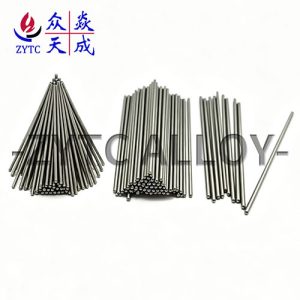
Product forms: round bar, flat bar, plate, wire, and tube, with custom machined parts available according to customer drawings.
-
Condition options: annealed, medium-hardened, and cold-worked conditions, meeting different needs from forging blanks to near-net-shape processing.
-
Size range: following industry practice, round bar diameters cover 8–60 mm, and lengths can be customized as required.
-
Quality assurance: each batch of material is accompanied by an original manufacturer certificate (EN 10204 3.1), achieving full traceability from melt heat number to finished product.
Applications
With its combination of biocompatibility, high strength, and corrosion resistance, 1.4472 is mainly used in the following applications:
-
High-load orthopedic implants: bone screws, bone plates, and intramedullary nails, especially thin-wall screw designs that require reduced cross-sectional dimensions.
-
High-activity joint prostheses: components in hip and knee prostheses subjected to cyclic loading.
-
Bone fixation devices and fixation systems: spinal rods and pedicle screw systems.
-
Cardiovascular interventional devices: high-nitrogen stainless steel demonstrates a mechanical-corrosion balance superior to L605 and 316L in coronary stent applications.
ASTM F1586 1.4472 represents the direction in which medical stainless steel is evolving from “adequate” to “optimized.” While retaining the processing friendliness and cost advantages of austenitic stainless steel, it achieves substantial improvements in strength and corrosion resistance through nitrogen alloying. With more than 30 years of special alloy supply experience and a strict quality control system, ZYTC Alloy provides stable, traceable engineered supply of 1.4472 material to global medical device manufacturers. For technical data sheets, samples, or custom processing solutions, please contact the ZYTC Alloy team.
Contact ZYTC Alloy Today
📧 Email: daisy@zytcsteel.com
📲 WhatsApp: +86 17335753350